In today’s ever-evolving talent technology space, adaptability is not just an advantage–it’s survival. Traditional outsourcing models are failing to meet the demands of enterprises, which are constantly seeking cost effectiveness, rapid scalability, and specialized knowledge. That’s where the build operate transfer (BOT) approach helps.
This framework isn’t new; it’s been widely used in infrastructure and public-private partnerships (PPP model). However, it’s difficult to ignore its growing applicability in the talent technology ecosystem. Whether it’s global capability centers (GCC) or specialized tech teams, organizations are rethinking how they grow, run, and eventually take control of their offshore or nearshore divisions through BOT contracts.
What is the Build Operate Transfer Model?
Essentially, the build operate transfer model is a strategic partnership tool that enables a business to establish a new operating center with low risk. Here’s how it typically works:
1. Build: A partner creates the necessary framework by hiring teams, enforcing legal structure, and establishing an optimized delivery environment.
2. Operate: The partner runs the operations efficiently for a certain period making sure it satisfies performance and quality standards.
3. Transfer: After the system matures, the ownership goes to the client, enabling them to take over a fully functional and optimized system.
Think of it as “outsourcing with an exit strategy.” Initially, the company benefits from outsourcing with respect to speed, scalability and competence–then seamlessly shifts to owning the operation once it’s sustainable.
Why the BOT Model Is Reshaping Talent Technology
Talent technology thrives on innovation, efficiency, and adaptability.The BOT model is ideal because it eliminates the “trial and error” phase that often precedes rapid tech expansion.
Why is it gaining traction?
Faster market entry: Businesses can set up operations in new regions without waiting for months.
Risk mitigation: The majority of the initial setup and compliance risks are incurred by the operational partner.
Talent access: There are large pools of competent tech talent in global markets, particularly in regions like Southeast Asia and India who are ready to drive digital transformation.
Knowledge transfer: The client inherits not only the people but also the processes, resources, and cultural basis.
This model is particularly valuable for GCCs.
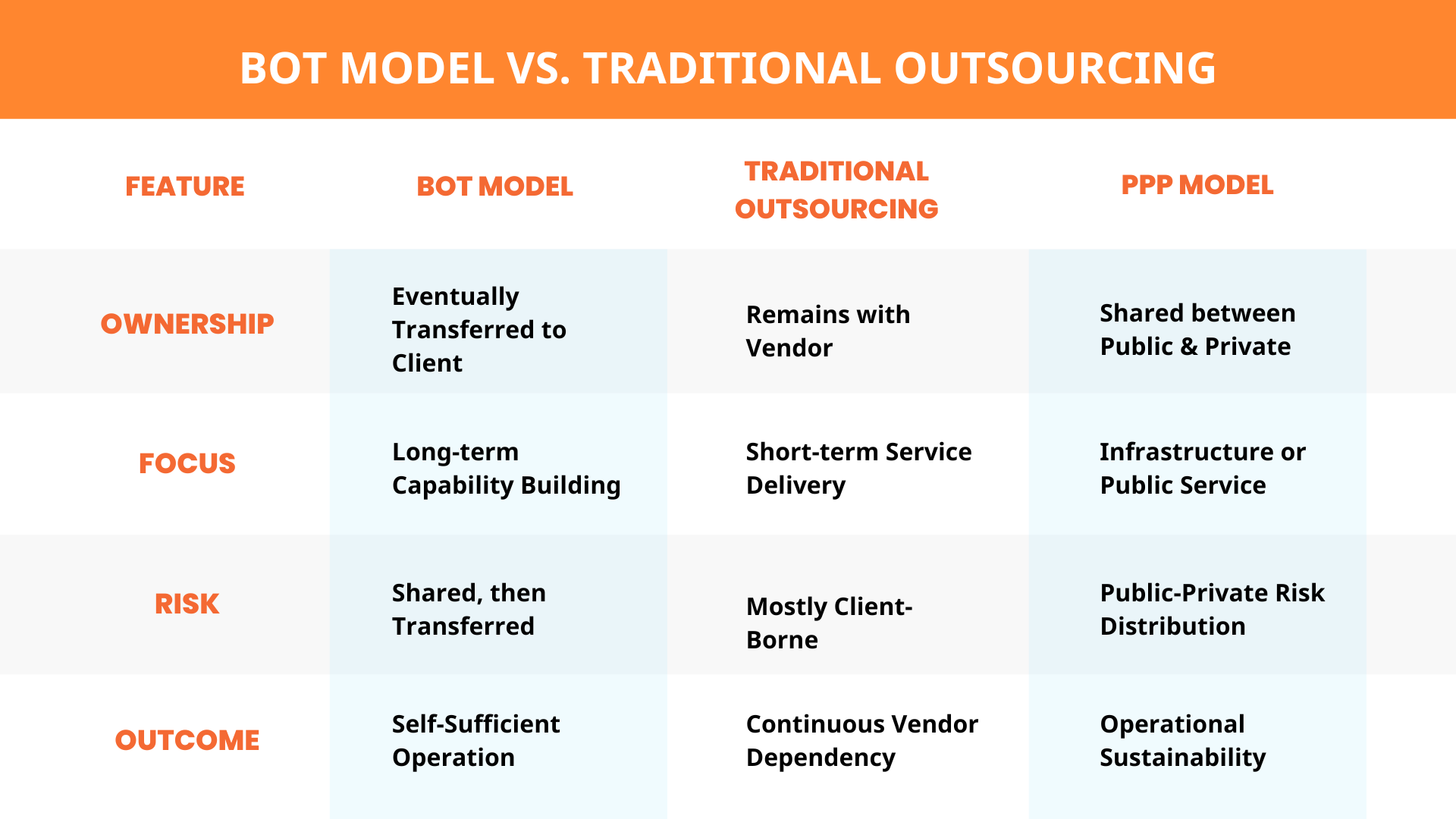
BOT Model vs. Traditional Outsourcing
In essence, the BOT contract gives businesses the best of both worlds—outsourcing agility with future autonomy.
The Rise of GCC Services with BOT Model
Global capability centers have become the backbone of enterprise innovation. Businesses, ranging from fortune 500 companies to rapidly emerging unicorns, are employing GCC services with the BOT model to create offshore innovation hubs in Eastern Europe, the Philippines, and India.
How does BOT boost GCC’s?
Speed to scale: BOT accelerates the setup of GCCs without the hassle of building from scratch.
Local expertise: Partners manage payroll, labor laws, and regional compliance, ensuring seamless operation.
Strategic transfer: Once the GCC hits maturity—often 18-36 months—it’s transferred to the parent company smoothly.
The outcome? Businesses receive fully operational GCCs that are tested, optimized, and ready for innovation from day one.
How BOT Empowers Talent Technology Providers
The way HR and staffing firms are building their delivery engines is being revolutionized by the build operate transfer model. What makes it so transformative?
Access to top talent without infrastructure hassles: It can get difficult to find, hire, and retain qualified tech workers. BOT partners eliminate months of planning by bringing in pre-existing HR frameworks, talent networks, and recruiting platforms.
Seamless technology integration: BOT suppliers ensure that the newest technologies are included throughout the "operate" phase, from AI-driven recruiting tools to HR analytics. The client receives an ecosystem that is ready for innovation when the center is transferred.
Scalability with flexibility: Whether you’re scaling up a 20-member data team or a 200-member tech hub, the model allows expansion without the usual operational constraints.
Cultural and process alignment: Unlike traditional outsourcing, BOT focuses on building a culture aligned with the client’s brand values and performance standards, making the transfer phase smoother.
Real-World Use Cases: BOT in Talent Tech Operations
This model is gaining traction across talent technology because it offers a practical way to build focused, high-impact teams. Below are some real-world examples showing how organizations are using this approach to strengthen their tech and innovation capabilities.
AI-Driven Recruitment Hubs: BOT is being used by talent tech companies to develop offshore AI and automation teams that build proprietary algorithms for smarter candidate sourcing.
Data Analytics Centers: Companies set up BOT-based GCCs focused on people analytics to provide projected insights into hiring trends.
R&D Labs: BOT is aiding HR tech companies in building specialized labs for creating workforce management and next-generation applicant tracking systems (ATS).
Key Advantages at a Glance
The build operate transfer model helps businesses to expand with confidence by combining external expertise with a seamless path to full control. A brief overview of the standout benefits this model offers is listed below:
Smaller initial investment with shared setup costs
Access to BOT partners' proven operational excellence
Easier transition to ownership with built-in knowledge transfer
Experts in compliance and risk management
Long-term viability via cultural alignment
Challenges and Considerations
Although the build operate transfer model is highly effective, it has its complexities:
Cultural alignment: Integration of a cross-border team needs effective change management.
Risk of knowledge loss: Transition phases can disrupt service or process continuity.
Regulatory compliance: Establishing a GCC or center abroad via BOT includes navigating through labor laws, tax systems and data protection.
Dependence on the partner during the operating phase: Success depends on a robust vendor relationship during the operating phase.
Time to maturity: While faster than establishing entirely solo, the BOT model still demands discipline, governance and investment until the operation is self-sustaining.
Shaping the Next Phase of Talent Tech
The build operate transfer model is changing how organizations approach talent operations and global expansion. For talent technology, it covers the gap between outsourcing efficiency and in-house ownership. As more companies embrace GCC services with the BOT model, the focus is shifting from “where we operate” to “how we build for the future.”
The takeaway? The BOT model isn’t just a structure—it’s a strategy. One which enables talent tech leaders to innovate faster, operate smarter, and scale sustainably.
FAQs
1. How long does a typical BOT contract last? Typically from 18 to 36 months, contingent on project complexity and operational goals.
2. What types of companies gain the most from the BOT model? Tech startups, HR tech firms, and enterprises setting up offshore GCCs or innovation hubs benefit the most.
3. How is the BOT model different from a PPP model? PPP is usually used in infrastructure projects between governments and private entities, while BOT is more appropriate for corporate operations and technological centers.
4. What are the primary risks in the BOT model? The primary risks are cultural misalignment or delays in the transfer phase, even though selecting an appropriate partner minimizes these.
5. Can BOT work for non-tech sectors? Yes! BOT is becoming increasingly common for international operations in sectors such as manufacturing, healthcare, and logistics, despite its popularity in talent and technology.




-p-1080.png)