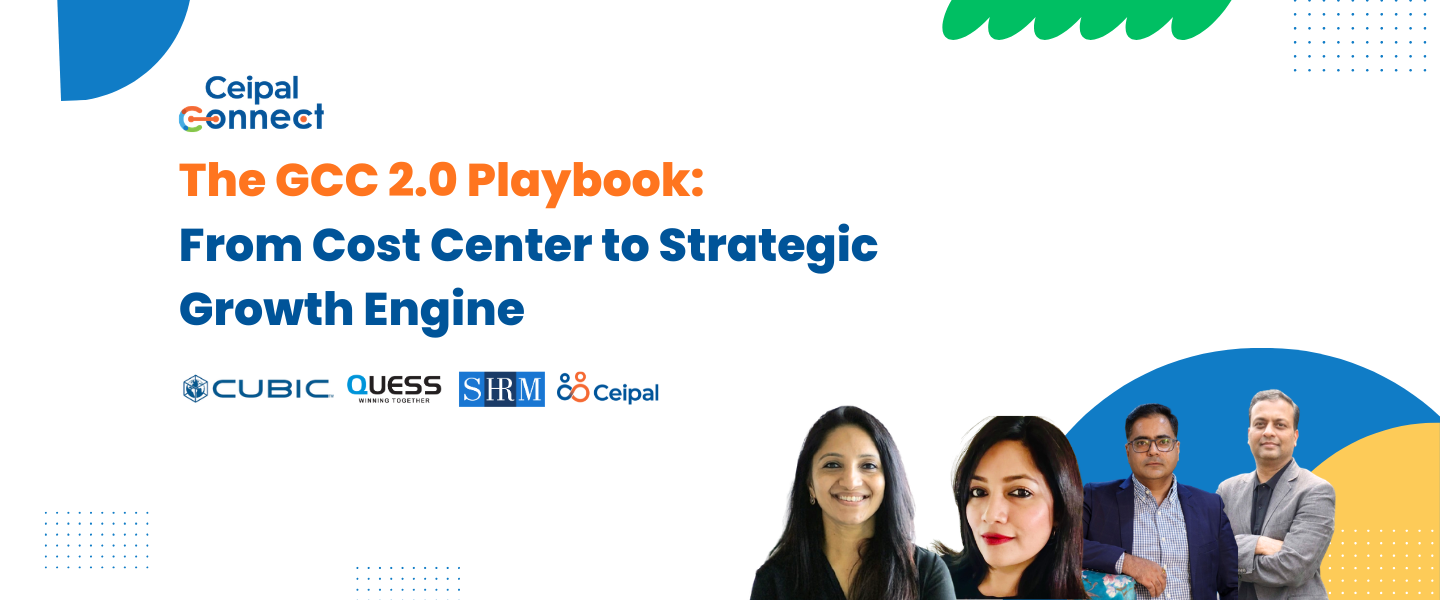
The Ceipal Connect panel discussion hosted by Gaurav Baid, Senior Director at Ceipal, painted a vivid picture of the evolution in Global Capability Centers (GCCs). With India home to over 1,700 GCCs, the session marked a turning point in how these centers operate, shifting gears from cost efficiency to strategic growth engines. The discussion revealed critical insights into the changing business models, talent frameworks, and the role of innovation-driven leadership in GCCs.
The panel featured insights from:
- Durgaraje Virendra Bheda, VP, Quess Corp
- Bhargavi D, Talent Acquisition Leader, Cubic Transportation Systems
- Shaakun Khanna, Senior Advisor, SHRM
Watch the full session below, or continue reading to learn the key takeaways.
The Transformative Journey: GCC 2.0
Opening remarks by Gaurav set the stage for conversation, highlighting India’s monumental shift from GCCs being cost-driven support units to becoming hubs of innovation, intellectual property (IP) creation, and strategic collaborators to global leadership. He described GCC 2.0 as the phase moving beyond metrics like cost savings and transactional execution toward cutting-edge innovation, strategy co-creation, and global business impact.
The overarching theme of the panel centered on how GCCs are now expected to deliver value through strategic contributions rather than acting purely as execution engines. As Gaurav stated, "These centers are no longer back office support. They are innovation hubs, IP creators, and strategic partners to the C-suite."
Evolution of Business Models
Shaakun Khanna, Senior Advisor at SHRM, underscored the shift in GCCs’ operational mandates. The era of benefiting solely from labor cost arbitrage is behind us, as countries like the Philippines emerge as competitive alternatives. Shaakun noted that GCCs are increasingly being viewed as profit centers, tasked with direct contributions to top-line (revenue) and bottom-line (profitability) growth.
He added, "Captive GCCs are now being asked what is the bottom line or top line contribution that they can directly make. Earlier, it was a very indirect contribution."
The changing nature of work is pivotal to this transition. Shaakun described a shift from routine, human-centric tasks to machine-human collaboration spurred by AI, coining the term "agentic as a service." This shift represents a significant evolution: GCCs are now expected to manage innovative initiatives, drive products, and serve external organizations outside their traditional parent company frameworks.
India’s Competitive Edge: Talent and Innovation
India remains a powerhouse in the GCC landscape due to its robust talent pool and growing AI capabilities. Shaakun highlighted India’s distinctive advantage, stating, "Not only do we have great human resource capability, I think we are also leading the edge when it comes to innovation with AI."
This innovation potential places Indian GCCs in a unique position to act as primary drivers of technological advancement for global organizations. GCCs in India are increasingly responsible for pioneering products and platforms that redefine their parent companies' strategies.
The Talent Challenge: Shifting Mandates
A key takeaway from the discussion revolved around the transformation in talent acquisition strategies. Durgaraje Virendra Bheda, AVP at Quess Corp, highlighted how the GCC mandate shift from efficiency-focused operations to strategic innovation necessitates changes in hiring practices.
Durgaraje pointed out that mid-level hiring has seen a significant rise—from 40% to 60%. This reflects the growing demand for skilled professionals in roles related to advanced technologies like AI, data science, and innovation. Furthermore, he stated, "The talent profile is undergoing a total DNA transplant—when mandates shift from efficiency to strategy, hiring must move from volume to value, process to product, and cost focus to capability building."
Despite the opportunities, GCCs face an imbalance in supply and demand for top talent. For every 10 open positions, there are only six job seekers, particularly for emerging tech roles. To address this gap, Durgaraje called for investment in internal training, reskilling, partnerships with universities, and enhanced collaboration in emerging domains.
Want to dive deeper into data? Check out the full GCC Talentscope Report from People Matters and Ceipal.
Employer Branding and Leadership Development
The panel touched on the importance of employer branding in attracting senior talent. Bhargavi D from Cubic Transportation Systems emphasized that GCCs must focus on crafting authentic Employee Value Propositions (EVPs). Authentic EVPs allow organizations to appeal to purpose-driven professionals, especially Gen Z workers who value meaningful impact over traditional brand allure.
Bhargavi highlighted that GCCs must prioritize hiring leaders capable of global influence. Profound leadership development, focus on strategy design, and the ability to act as cultural ambassadors are key to overcoming perception gaps between Indian GCCs and global headquarters.
She remarked, "Talent acquisition now is about acquiring the future at a premium cost... It's no longer about brand anymore; it's about the purpose and how much meaningful the work they are going to do and the influence they will have."
Driving Innovation Through Leadership
The discussion also delved into the leadership gap in Indian GCCs. As cited by Durgaraje, although India hosts over 55% of global GCCs, only 10-15% of GCC leaders are homegrown. Opportunities for transformation ownership at an early stage could bridge this gap and elevate leadership capabilities.
Building leadership trust is central to ensuring GCC success. As Bhargavi noted, leaders capable of aligning GCC efforts with global business objectives build credibility with headquarters and position their centers as strategic drivers.
Preparing for the Future: Practical Insights
Concluding the session, Gaurav, along with panelists, packaged the conversation into actionable insights. The transformation in GCC mandates demands rapid change, reskilling, and a proactive mindset to embrace disruption.
Key Takeaways
- GCCs are evolving into strategic profit centers, delivering business impact via innovation and leadership contributions.
- The talent strategy now focuses on hiring for capability, skill-based roles, and long-term transformation rather than volume.
- Employer branding must be rooted in authentic, purpose-driven messaging, especially for senior and Gen Z talent.
- Leadership development and trust-building between Indian GCCs and global leadership remain critical to success.
- India’s advantage lies in its talent and AI capabilities, enabling GCCs to act as innovators for their parent companies.
Final Notes
The session left attendees equipped with actionable ideas on how GCCs can redefine their futures in the age of AI and rapid innovation. Leaders must now focus on creating purpose-driven roles, measuring business outcomes beyond cost metrics, and addressing the leadership gap through strategic development. As Shaakun concluded, "Don’t just deliver; disrupt."
Transforming cost-focused GCCs into innovation hubs will not be without challenges, but with strategic talent acquisition, authentic branding, and leadership trust, Indian GCCs are well-positioned to lead on a global stage.




-p-1080.png)