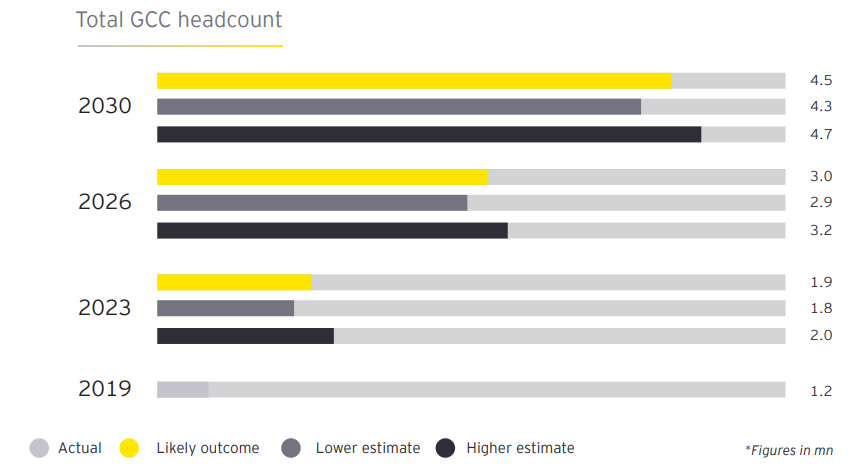
India now hosts over 1,800 Global Capability Centers more than half the world's total employing nearly 2 million professionals and generating $64.6 billion in revenue in FY2024. The growth is extraordinary.
But growth at this pace creates a problem most GCC leaders are not fully prepared for. The Ceipal GCC Talentscope India 2026 Report found that 58% of GCCs take more than 45 days to fill critical roles, and 50% are making hiring decisions without predictive analytics.
The bottleneck in India's GCC story is no longer real estate or legal setup. It is talent infrastructure the systems, processes, and governance frameworks that determine whether a GCC can hire at speed, scale with confidence, and operate with visibility.
India’s GCC Boom: A Shift From Scale to Strategy
India now hosts over 1,800 GCCs and employs nearly 2 million professionals, generating $64.6 billion in export revenue in FY2024, a 40% jump year-over-year.
The pace has only accelerated with new GCCs launched in India spanning sectors as diverse as banking, pharmaceuticals, retail technology, and sports streaming, the entry profile of organizations choosing India has never been broader or more strategically significant.
Important changes that define this boom include:
Expansion into Tier-2 cities beyond Tier-1 metros
Delivery models that are dispersed among several places
Higher hiring volumes and quicker ramp-ups
GCC enablers and BOT providers coordinating multi-location setups face an additional layer of complexity, managing talent operations across client GCCs simultaneously, each with their own governance requirements, vendor ecosystems, and compliance obligations.
As GCCs grow larger and more complex, organizations are realizing that simply increasing headcount is not enough. The real challenge lies in sourcing, managing, governing, and optimizing at scale.
The New Reality: GCC Growth Brings Talent Complexity
The environment in which modern GCCs are operating is far more challenging than it was in the past. Hiring is no longer simple or centralized; rather, organizations deal with:
Multiple hiring locations working at the same time
Diverse talent requirements across engineering, analytics, AI, cybersecurity, and operations
An excessive dependence on vendors, partners, and contract workers
Increasing demands for data visibility, transparency, and compliance.
Pressure to shorten time-to-hire and reduce costs without sacrificing quality
In this setting, fragmented systems and disconnected tools can quickly create bottlenecks. Recruiters lose productivity, leaders miss insight, and scaling becomes reactive rather than strategic.
These are not isolated friction points — they are the root causes behind the GCC hiring challenges that most India-based centers are actively struggling to solve in 2026, from rising competition for niche skills to fragmented vendor ecosystems and slow time-to-fill.
This is where the focus shifts from talent tools to the talent infrastructure. To manage this complexity effectively, GCCs need more than hiring tools; they need a strong, scalable talent infrastructure.
Why Talent Infrastructure Matters More Than Ever for GCCs
Talent infrastructure is more than just hiring software. It connects people, processes, data, and decisions throughout the entire talent lifecycle.
For GCCs operating at scale, infrastructure affects:
How quickly teams can be built
How consistently processes are followed across cities
How effectively vendors and partners are managed
How confidently can you make workforce decisions
Without solid infrastructure, sustaining GCC growth becomes tough, especially as operations expand across various cities and talent markets. For captive GCCs building operations from scratch, getting infrastructure right in the first year determines how quickly the center reaches operational maturity and how confidently it can scale beyond its initial headcount targets. In many ways, talent infrastructure for GCCs is as important as physical infrastructure. Just like office space, connectivity, and security support operations, talent systems support scale, speed, and stability.
What Modern GCC Talent Infrastructure Must Enable
To meet today's GCC demands, talent infrastructure needs to go beyond basic applicant tracking. Here is what it must actually enable:
AI-driven sourcing and screening at scale- GCCs hiring across Bengaluru, Pune, Hyderabad, and emerging Tier-II cities simultaneously cannot rely on manual sourcing. AI-powered matching, automated screening, and intelligent candidate ranking are operational requirements, not advanced features.
Real-time workforce visibility- GCC leaders need live dashboards showing hiring progress, workforce composition, vendor performance, and compliance status. Decisions made without this visibility are decisions made in the dark.
Standardized processes across locations- Consistency breaks down when every city runs its own hiring workflow. The same hiring standards, onboarding checklists, and compliance protocols must apply whether you are scaling in Chennai or Coimbatore.
Vendor and contract workforce governance- As GCCs increasingly rely on blended workforces, permanent employees, contractors, and outsourced partners, managing multiple vendors under a single governance framework is the foundation of operational control.
Ceipal’s Role in Powering GCC Talent Infrastructure
At Ceipal, we see firsthand how GCCs struggle when talent systems fail to keep pace with growth. That’s why our platform is designed not as a point solution, but as an AI-powered talent infrastructure automation platform built for scale.
Ceipal helps GCCs:
Access larger and more diverse talent pools through AI-powered sourcing and screening
Maintain centralized visibility across hiring, onboarding, and workforce operations
Standardize processes across Tier-1 and Tier-2 locations
Automate vendor, compliance, and workforce workflows
Improve recruiter productivity while reducing cost per hire
Whether organizations are launching a new GCC or scaling existing operations across cities, Ceipal provides the systems layer that enables consistency, speed, and control without adding operational overhead.
For GCC advisory firms designing the talent framework for a client's new center, Ceipal provides the infrastructure layer that turns advisory recommendations into operational reality from sourcing workflows to vendor governance and workforce analytics.
Infrastructure Will Define the Next Phase of GCC Growth
India’s GCC boom is far from over. The next wave of growth will likely be more spread out, more specialized, and more focused on talent.
Looking at the Global Capability Centers boom in India, it's clear that the next phase will be a more gradual, more specialized, and more talent-driven affair. Coming from that understanding, we can expect the following developments:
The GCCs will continue to spread to larger Tier-1 cities and Tier-2 cities
GCCs will be characterized by more sophisticated AI, analytics, and digital engineering services.
People will be the key to the growth of these GCCs, and so companies will be under pressure to hang on to them and improve their work experience.
Lastly, have higher standards for governance, leadership, financial transparency, and efficiency.
In this future, organizations that invest early in flexible talent infrastructure will be best positioned to grow confidently and sustainably.
Ceipal: The Talent Infrastructure Behind India’s GCC Growth
India’s GCC success story is unfolding right now. As organizations grow faster and expand further, talent infrastructure will decide who leads and who falls behind.
Ceipal is proud to support this change, helping global capability centers hire smarter, operate smoothly, and scale confidently, no matter where they build.
Frequently Asked Questions
What is GCC talent infrastructure? GCC talent infrastructure refers to the systems, processes, governance frameworks, and technology platforms that enable a Global Capability Center to hire, onboard, manage, and scale its workforce efficiently — including ATS, vendor management, analytics, and compliance workflows.
Why is talent infrastructure critical for GCCs in India? As GCCs scale across multiple cities with diverse skill requirements, fragmented tools create bottlenecks that slow hiring and reduce visibility. Talent infrastructure ensures consistency, speed, and governance across every location.
What happens when GCC talent infrastructure is inadequate? Without strong infrastructure, GCCs face longer time-to-fill, poor vendor governance, compliance risks, and data-blind hiring decisions. 58% of GCCs in India take over 45 days to fill critical roles, a direct consequence of infrastructure gaps.
How does Ceipal support GCC talent infrastructure? Ceipal provides an AI-powered talent infrastructure platform covering sourcing, screening, vendor management, workforce operations, and analytics — purpose-built for GCC scale.
Curious to learn more about how Ceipal can help? Contact us, and we’ll get back to you ASAP.





-p-1080.png)