There is a number most GCC talent leaders never see on a dashboard.
It shows up quietly in a project that slipped a quarter, a team that missed its sprint, a senior engineer who started looking elsewhere because the new hire kept dropping the ball. By the time anyone connects the dots, the damage is already done.
That number is the cost of a bad hire. And in an Indian GCC environment, it is larger than most organizations want to admit. As GCC hiring becomes more complex, companies are increasingly relying on platforms like Ceipal to bring more visibility and intelligence into hiring decisions.
What a Bad Hire Actually Costs in India's GCC Market
According to research from the U.S. Department of Labor and industry hiring studies, a bad hiring decision can cost organizations up to 30% of the employee’s annual salary.
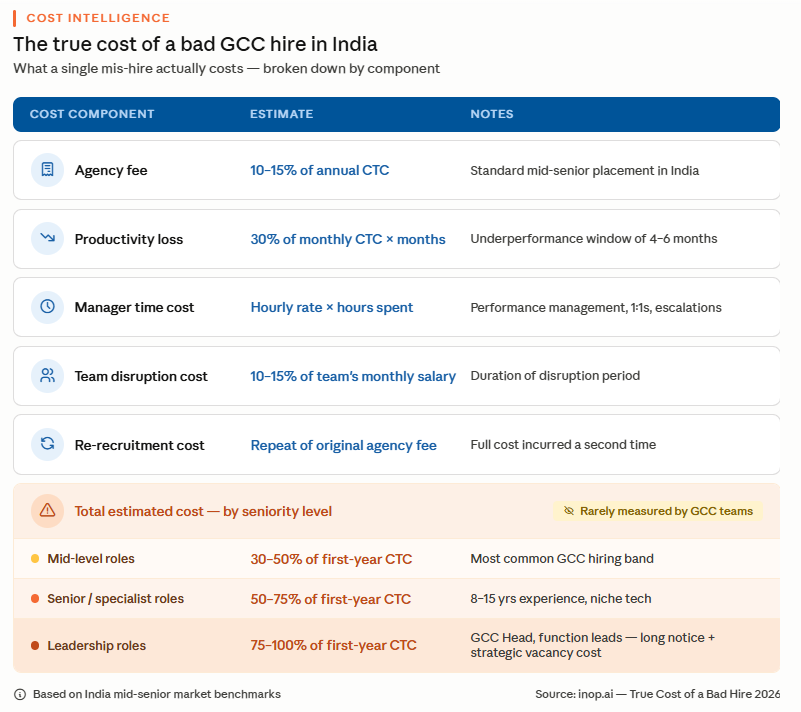
In the Indian mid-senior GCC market, the cost of a bad hire ranges from 50% of first-year CTC for mid-level roles to 100% or more for senior and leadership positions, driven by India's long notice periods, repeated recruitment costs, and the strategic cost of vacancy at senior levels
Long notice periods absorb salary without productivity.
Notice periods for senior professionals in India are normally between 60 and 90 days. A bad performer whose performance was below expectations during the tenure of 4-6 months and who quit on notice period of 90 days will result in the company having to bear the burden of paying his salary for 7-9 months.
Re-recruitment costs repeat from scratch.
For mid-senior level recruitments, 85% of the time, the same recruitment agency or the same online portal is used in India in case of failure of the re-recruitment process. Normally there is no cause for analysis carried out before the recruitment process resumes again, resulting in doubling up of the cost incurred for re-recruitment.
Team disruption has a real price tag.
According to GCC Pulse, 85% of HR professionals state that even a single poor hiring decision leads to low morale & performance amongst other members of the team. In a GCC where high performers are already fielding external offers, one mis-hire on a team can trigger secondary attrition that costs far more than the original replacement.
Here is a practical cost breakdown for a typical GCC mid-senior hire in India:
Why Quality of Hire Is the Metric GCC Teams Are Not Measuring
Most GCC recruiting teams still measure the wrong things. Time-to-fill gets tracked obsessively. Cost-per-hire gets reported to leadership every quarter. Quality of hire gets left on the whiteboard as a "nice to have.
According to SHRM's 2025 Recruiting Benchmarking Report, only 20% of organizations track quality of hire in a meaningful, data-driven way—despite 89% of talent acquisition leaders calling it their top priority
The quality of hire is not one number. It is based on how new employees perform after they join the company. Recruiters should track the quality of hire.
Quality of Hire (QoH) Score = (Performance Rating + Retention Score + Hiring Manager Satisfaction + Time-to-Productivity) ÷ 4
Each component is scored on a 1–100 scale. A score above 70 is strong. Below 50 should trigger a process review, not just a replacement search.
In a 2025 recruiting survey by LinkedIn, 31% of recruiters now name quality of hire their top hiring metric ahead of cost per hire and time to fill. The shift is happening. The question is whether your GCC is ahead of it.
The Warning Signs You Are Already Paying for Bad Hires
The impact of a bad hire is rarely an overt one. It comes through as patterns that GCC managers typically trace back to different issues:
High 90-day attrition.
90-day exits usually signal a hiring or onboarding miss. 6-month exits often mean the role was misrepresented. 12-month exits start to reflect management and growth, not selection. If your early attrition is clustering, the problem is upstream.
Manager bandwidth drain.
When the manager in charge of the hire is spending over 20% of their time addressing performance gaps with the newly hired person, it is clearly a selection error. And it is certainly not a cost that appears on any HR reports.
Delayed delivery milestones.
In cases where the GCC is linked to the timeline of the global product or platform release, a new employee taking until the 5th month to become productive would have delayed the process by 3 months. This delay is actual. Yet it never gets attributed back to the decision to recruit.
The Infrastructure Gap Driving the Problem
The problem with quality of hire being left out as a metric within GCCs has nothing to do with intention; it is simply because of the technology infrastructure that they have.
Their ATS tracks applications and offers. Their HRMS tracks headcount and payroll. Neither system is built to connect pre-hire signals to post-hire outcomes like performance, retention, and time-to-productivity.
58% of GCCs take more than 45 days to fill critical roles
50% are making hiring decisions without predictive analytics
Agentic AI in recruitment is the #1 HR tech priority
Speed pressure drives poor GCC hires underground. With 58% of GCCs already out of the sweet spot for hire times, the natural inclination is to speed things up rather than slow down. The end result is always hires that pass muster upfront but prove very expensive six months on.
How to Start Measuring Quality of Hire in Your GCC
You do not need a perfect system. You need a consistent one. Here is where to start:
Define success before you hire.
Every role requires a success profile, not just a job description. What does excellence in performance mean after 90 days? After 6 months? This determination should happen before your recruiting effort begins. It is by far the most important thing that GCC HR teams can accomplish.
Run 30/60/90-day post-hire reviews.
Just a simple survey of your hiring managers at each of those stages, three or five calibrated questions will provide valuable data points that you currently lack. The same measures of performance, productivity, and culture fit are consistently observed over time.
Calculate QoH scores quarterly.
By role type, hiring source, and hiring manager. Who are your best hires? Who are your worst hires? That's the data point you need to make improvements to your process.
Connect pre-hire signals to post-hire outcomes.
What signals indicate future attrition? Which recruitment sources generate high performers? You’re turning the quality of hire from a report card into a forecast model—one where you outsmart your previous hire every time.
This level of visibility is only possible with the right talent infrastructure in place. Modern GCCs need technology that can connect pre-hire data with post-hire outcomes—bringing sourcing, hiring, workforce management, and analytics into a single ecosystem. Platforms like Ceipal help GCCs move beyond reactive hiring and make more predictive, data-driven talent decisions at scale
The Future of GCC Growth Will Be Built on Talent Infrastructure
A bad GCC hire isn’t an issue for the hiring manager – it’s a systems issue.
It happens when the process is optimized for speed, when the talent infrastructure cannot connect pre-hire decisions to post-hire outcomes, and when quality-of-hire is more of an aspiration than a true measure.
The winners in 2026 will be GCCs that don’t focus on hiring the quickest; instead, they will be the GCCs that have the data needed to understand what makes for a great hire, where to find them, and how to avoid problems.
Want to learn more about Ceipal? Set up a quick demo to see how the platform can support your goals.





-p-1080.png)