If you are leading talent strategy at a Global Capability Center, that trajectory is not a footnote in a trends report. It is a direct challenge to how you are planning your workforce right now.
But here is the thing: this is not a conversation about contract versus permanent. It is a conversation about getting the mix right. Because GCCs that default entirely to permanent hiring are leaving agility on the table, and GCCs that over-rotate into contract staffing are quietly eroding institutional knowledge and culture.
The data is clear. The strategy, for many GCC leaders, is still being figured out.
In this blog post, we explore the numbers, explain the underlying structural drivers of this shift, and provide an actionable framework for crafting your GCC workforce model.
The Numbers That Should Change How You Think About This
Let's begin with the numbers first, since the magnitude of change can easily be underestimated while looking at the issue on a role-by-role basis.
This shift is primarily being seen among AI/ML and platform engineering projects with a defined scope. The full-time hiring continues to dominate, but not among the niche-skill categories, where the overall trend confirms this observation:
GCCs are expected to generate about 4.25 to 4.5 lakh new job opportunities in FY26, with Q4 hiring expected to grow 12 to 14% QoQ, which is the best figure since 2022.
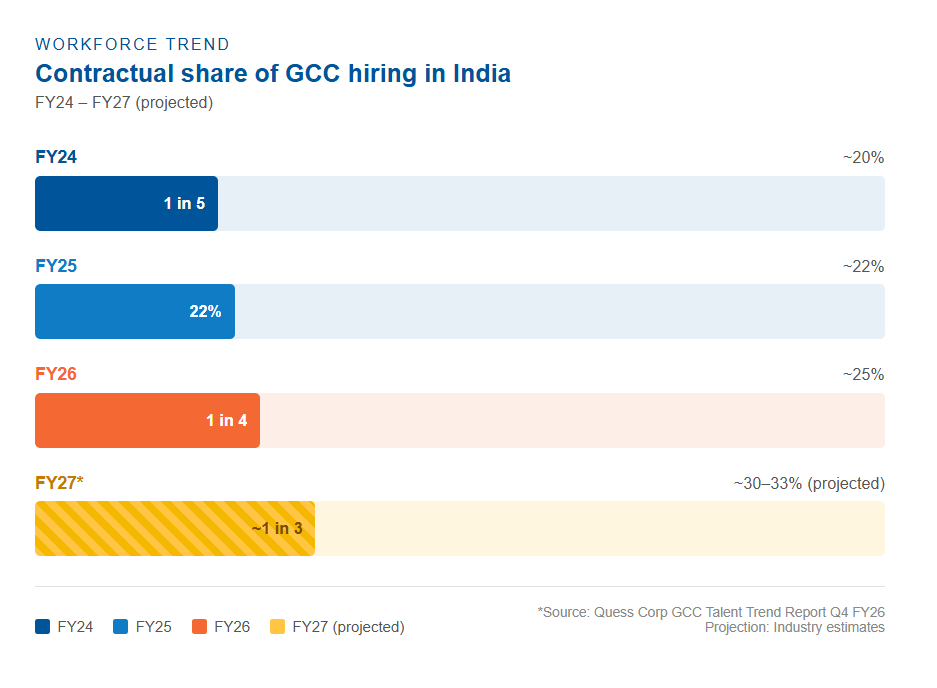
Niche skills have become a 1.7x salary premium, and one out of four GCC jobs will be contractual by the end of this year.
The total GCC workforce in India stands at about 2.4 million, from 1.9 million in 2024 and is expected to cross the 3 million mark by 2030.
The workforce is not just growing. It is changing shape.
Here is a visual representation of how the contractual share of GCC hiring has trended:
Why Contract Hiring Is No Longer a Fallback
Contractual hiring in GCC firms was traditionally viewed with suspicion. It was considered a last resort, which people resorted to when they failed to get the correct permanent employee or faced restrictions on their headcount budgets. The paradigm shift is here.
The firms employing contractual staff in India are no longer viewing their contractual headcount as a last resort. Instead, it has become a planned approach.
Here is what is actually driving it:
1. The AI Skills Deficit Is Forcing Speed
Estimates from the industry place the deficit of skilled personnel in India in AI at around 53% for every two positions advertised, which means that less than one qualified person can be found for every two positions posted. In a situation where hiring is not always possible on time, temporary solutions are critical. An engagement period of six months for developing a GenAI proof-of-concept does not justify a permanent hire. It justifies a specialist contractor with a defined outcome.
2. Contract-to-Hire Is Delivering Better Retention
As per Quess Corp's Q4 FY26 GCC Trends Report, the Contract-to-Hire (C2H) methodology provides 15-20% higher retention rates than those of direct permanent hiring processes. GCCs are using it as a filtering mechanism rather than a quick-fix process.
The logic is straightforward. As both employer and employee validate their compatibility with each other through C2H in 3-6 months, there will be no assumptions on cultural fitment, competency levels, and job requirements. The first three months that are crucial in terms of attrition rates for permanent employees are already done as part of the contract phase.
3. The Onboarding Speed Advantage Is Real
Quess Corp's GCC Trends show contract-to-hire onboards at a 40-50% faster speed than permanent hires. In an industry where niche tech roles take more than 90 days to fill on average, this difference could mean a project being delivered on time or delayed by a quarter.
4. Gen Z Tenure Is Reshaping the Math
Gen Z tenure in GCCs is now less than 24 months, leading to a 40% replacement hiring ratio. This translates into one out of every two hires you make being a replacement hire, rather than adding to your staff. The contractual nature of such a model lends itself better to such turnover.
5. Macroeconomic Caution Is Accelerating the Shift
The rise in flexible hiring is also linked to macroeconomic uncertainty, prompting companies to remain cautious about adding fixed costs. Instead, firms prefer to develop capabilities based on their needs at the time, employing specialists in areas like artificial intelligence, data, cybersecurity, and product transformation only when necessary.
Another trend that is gaining traction is the realization that skills employed by the company today will likely be outdated in 18 to 24 months.
Where Permanent Hiring Still Wins and Always Will
None of the above is meant to suggest that permanent hiring is losing relevance. Instead, it shows that the scope of its utility is increasingly clear.
Here is where permanent hiring remains the right answer:
Core leadership and strategic roles.
GCC Head, function leads, and senior architects carry institutional knowledge that simply cannot be contracted in and out. These roles define culture, maintain global stakeholder relationships, and make decisions that compound over the years. Contract models are not built for this.
Roles requiring deep institutional context.
If you hire finance controllers, legal leads and compliance officers, they need to know about the history of decisions made at your institution, not just the current assignment. That kind of knowledge does not come from contractual tenure.
Building capabilities over a long period.
If you want to build an AI platform, implement a digital transformation over several years or create a roadmap that spans three to five years, you need individuals who will be able to stay on board. Contracting them will undermine your efforts. Team building in established centers requires permanent hiring.
The Blended Workforce Model: What Getting It Right Actually Looks Like
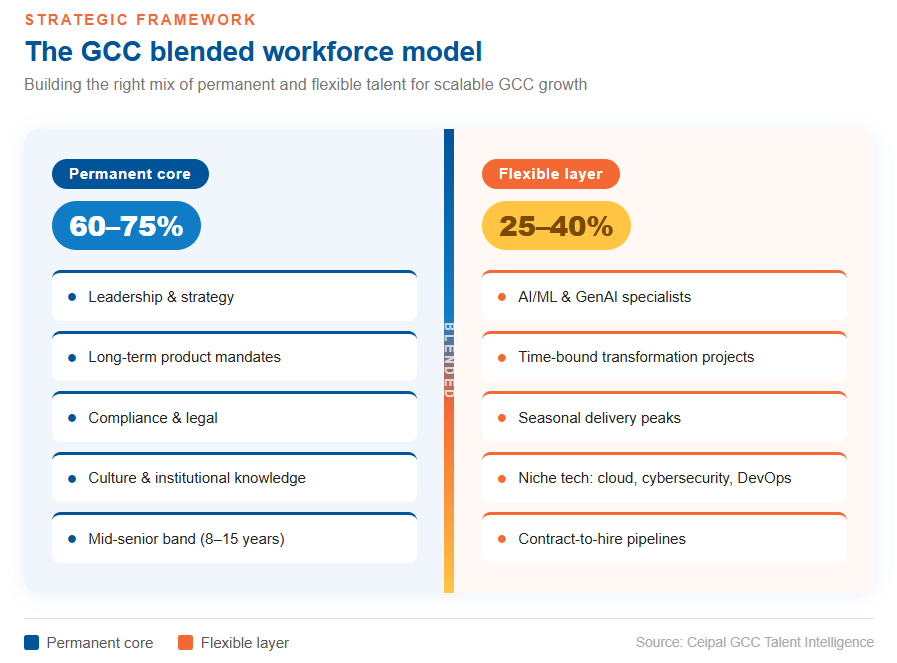
GCCs succeeding in this context do not have to make the choice between contracts and permanence. They are deliberately building a hybrid approach, and the distinction between deliberate and accidental is everything.
EY India's GCC Sector Lead Arindam Sen describes the direction clearly: "Contract hiring has been gradually increasing from the high teens a few years ago and may continue to rise as transformation programmes become more continuous than episodic." He added that over time, this could lead to a two-layer workforce model, reflecting how GCCs in India are evolving into mature, transformation driven eco systems.
The shift toward a blended workforce allows GCCs to scale rapidly by bringing in experts for specific migrations, testing capabilities using contract-to-hire models to ensure cultural and technical fit, and de-risking growth by maintaining agility during volatile global market shifts.
The critical insight here is that the ratio is not fixed. It shifts based on:
GCC maturity stage: a center in its first year needs more contractual flexibility; a scaled center needs more permanent stability
Geography: new Tier-II city setups benefit from contractual pilots before permanent scale-up
Role-Type Decision Matrix: Contract or Permanent?
Here is a practical tool for GCC talent leaders to use at the role level
The Compliance Reality Nobody Talks About Enough
Getting the mix right is not just a talent strategy question. It is a legal and compliance question, and GCCs that treat it as an afterthought create real operational risk.
Key compliance considerations for contract hiring in India:
CLRA Registration. Your registered entity in India must register as a principal employer under Section 7 of the Contract Labour (Regulation and Abolition) Act once you engage 20 or more contract workers. The staffing agency's license does not replace your registration.
PF and ESI obligations. Statutory employer contributions covering PF and ESI run approximately 13.5% of gross wages. This applies to contract workers engaged directly.
Fixed-term employment. Fixed-term employment contracts are legally recognized under the Industrial Employment (Standing Orders) Central Amendment Rules, 2018, giving GCCs a compliant structure for defined-tenure roles without resorting to perpetual contract extensions.
The misclassification risk. If a role has become operationally continuous, the legally correct path is permanent employment or an EOR arrangement, not another contract extension. GCCs that repeatedly roll over contracts on the same individual for the same ongoing work expose themselves to labour law risk.
A structured approach to vendor and contractor governance, including proper documentation, clear milestones, and defined conversion protocols, is not optional. It is the foundation of a compliant blended workforce model.
The Talent Infrastructure Gap Behind the Mix Problem
Flexible staffing models are becoming increasingly common across India’s GCC ecosystem. This is no longer something that sets them apart. It is the basic setup they need. Most GCCs are working with a mix of contract workers.
Their ATS was designed for permanent hiring workflows. Their vendor management systems are siloed from their core hiring pipeline. Their analytics cannot tell them contract-to-hire conversion rates, contractor time-to-productivity, or blended workforce cost-per-hire.
This means that even though they have a mix of workers, they can't see it in their data. They can't make their workforce better because of this.
58% of GCCs take more than 45 days to fill critical roles
50% are making hiring decisions without predictive analytics
Agentic AI in recruitment is the #1 HR tech priority, yet most hiring infrastructure is not built to support it
A blended workforce strategy requires a unified talent infrastructure, one that manages permanent hiring, contract workflows, vendor coordination, and hiring analytics under a single operational layer. Without that, the mix is not a strategy. It is just a collection of disconnected hiring decisions.
What the Best GCCs Are Doing Differently
Based on the data and market patterns, here is what deliberate blended workforce leaders are doing that others are not:
Building C2H pipelines, not just C2H transactions.
The best GCCs maintain a live pipeline of pre-vetted contractors who are actively being evaluated for permanent conversion. They treat every contract placement as a 90-day trial, not a project assignment.
Defining conversion milestones upfront.
Conversion from contract to permanent is not a spontaneous decision in high-performing GCCs. It is a structured milestone with pre-agreed criteria, performance benchmarks, team integration signals, and role continuity assessment.
Using pre-boarding engagement for contractors.
Companies are thinking less in terms of headcount and more in terms of capability. Instead of hiring one broad role, they're breaking it down into specific skills and bringing those in as needed. Pre-boarding engagement, keeping contractors warm and informed before day one, dramatically reduces early-tenure disengagement.
Treating vendor governance as a strategic function.
Multi-vendor contract hiring without governance creates quality inconsistency, compliance risk, and cost leakage. Leading GCCs have centralized vendor coordination with SLA accountability, not a dozen one-off staffing relationships.
Tracking blended workforce metrics separately.
Contract-to-hire conversion rate. Contractor time-to-productivity. Cost-per-hire by model. Early attrition by hire type. These metrics do not exist in most GCC talent dashboards, but they are exactly the signals needed to optimize the mix over time.
The Question Every GCC Talent Leader Should Be Asking
Not "Should we hire contract or permanent?"
The real question is: "Is our current workforce mix the result of a strategy or just the accumulated output of individual hiring decisions?"
If you cannot answer that confidently, you are probably running a default model not a deliberate one.
And in a market where one in four GCC roles is projected to be contractual by year-end, with niche skills commanding 1.7x salary premiums, the cost of a default model is compounding every quarter.
Getting the mix right is not a one-time exercise. It is an ongoing talent infrastructure decision. And it starts with having the visibility, governance, and systems to manage both sides of the workforce, not just one.
The Future of GCC Hiring
The contract versus permanent debate is the wrong framing. It implies a choice. The reality is that modern GCCs need both in the right proportions, for the right roles, with the right governance holding it all together.
The GCCs building that infrastructure now are not just solving a hiring problem. They are building a workforce model that will scale with their ambitions, not against them.
Want to learn more about Ceipal? Set up a quick demo to see how the platform can support your goals.
FAQ’s
Q: What is the ideal contract-to-permanent ratio for GCCs in India? A: As per industry statistics, the optimal ratio of scalable GCCs in India is 60-75% permanent employees and 25-40%contractors, though the ratio depends on many parameters, including the maturity level of the organization and the number of pipeline projects.
Q: What is Contract-to-Hire (C2H)? Why are GCCs using this approach? A: In this scenario, the contractor is evaluated initially for 3-6 months prior to employment. GCCs are adopting this strategy as this gives them a 15%-20% improvement in retention when compared to directly hiring employees permanently.
Q: What compliance requirements need to be followed while hiring contractors in India by GCCs? A: GCCs having 20 or more contract workers are required to register themselves under the Contract Labour (Regulation & Abolition) Act. PF and ESI requirements are applicable, and there is a heavy legal penalty if the employee's job role is misclassified as a contractor





-p-1080.png)