Build vs. buy: The hidden cost of building your own ATS
AI makes it look easy to build your own applicant tracking system. Here's what the business case usually leaves out and what it actually takes to compete on hiring speed.
Ask a talent leader what's changed about software in the last two years, and the honest answer usually isn't the interface. It's who's allowed to build it.
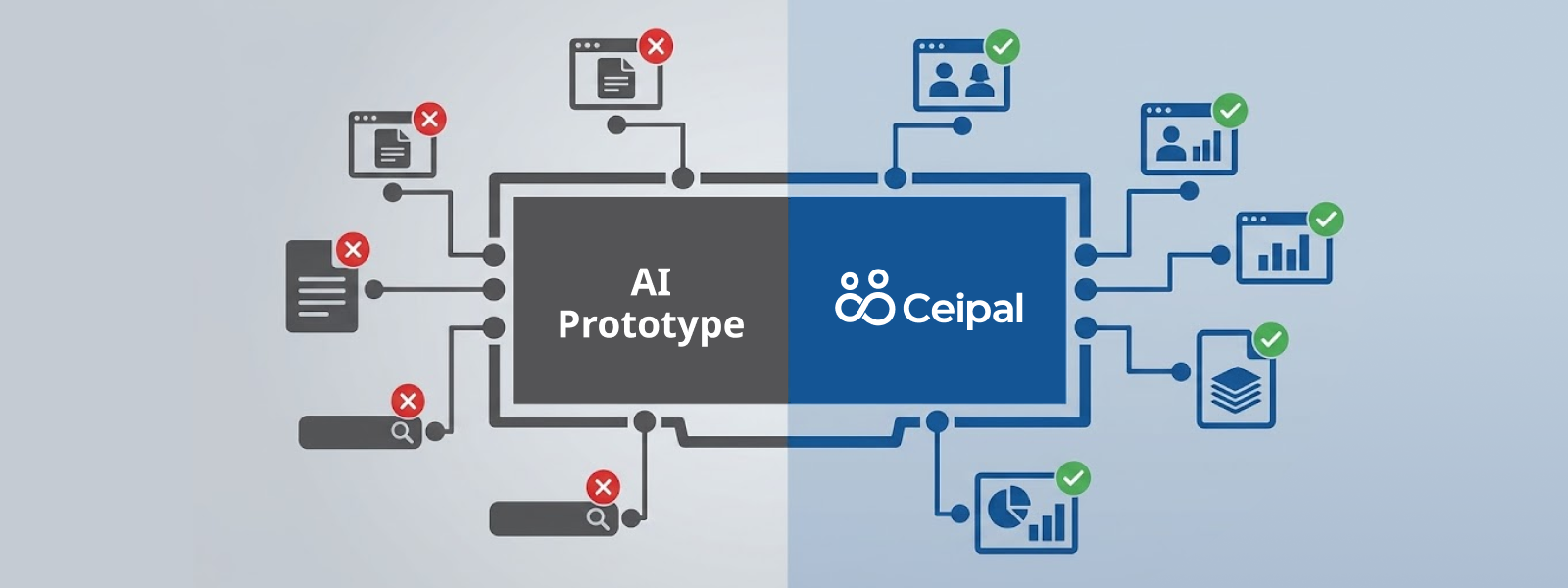
A developer with a modern AI coding assistant can go from a blank editor to a working prototype in an afternoon. That's what "vibe coding" looks like in 2026 and it's exactly why building your own ATS suddenly feels like a line item someone on your team could ship this quarter.
Here's the reality: that speed is real. A prototype in a couple of weeks is genuinely achievable now. What it doesn't tell you is what happens in month six, month twelve, or month twenty-four when that prototype has to become production software that fifty recruiters lean on every day, holding real candidate data, real client SLAs, and real compliance requirements.
This is the build vs. buy ATS conversation happening inside almost every staffing firm right now. AI has genuinely changed one half of it. It hasn't touched the other half at all.
Why "just build it" feels like the obvious call right now?
Something did shift, and it's worth naming plainly instead of waving it away. Developers using AI pair programmers complete tasks meaningfully faster than they used to - GitHub's own research on Copilot found a roughly 55% speed gain on a defined coding task, and broader estimates from McKinsey put the productivity lift from generative AI at 20–45% of total development effort. Low-code and AI-assisted tooling have both matured to the point where a working prototype, the kind that used to take a quarter, can now come together in a sprint.
For a talent and technology leader staring at next year's software budget, that's a genuinely tempting picture. The pitch usually rests on three assumptions:
Writing the code costs next to nothing, since AI does most of it
Owning the code means owning every decision, not waiting on a vendor's roadmap
Cutting the license fee looks like a clean win for the budget
All three hold up on day one. None of them survive contact with month six.
There's a deeper reason AI-generated code struggles here, too, and it's not about code quality. A general-purpose AI assistant has no idea what a strong light-industrial placement looks like, which skills predict longevity in a healthcare contract role, or how to weight a candidate's placement history against a specific client's fill patterns. That kind of judgment comes from years of placement outcomes, not from a well-written prompt. It's the difference between software that looks like an ATS and software that actually understands staffing.
The six-month reality check
Here's where the AI-build pitch quietly runs out of road. A prototype is not a product, and the gap between the two is exactly where staffing firms get surprised.
Six months in, engineering time starts going somewhere different than it did at first. Instead of new features, it goes into the parts nobody demos. The security model needs hardening. Uptime has to hold as usage grows. Integrations get wired up one at a time. QA cycles run to catch the edge cases real recruiters find in week one. This isn't just a feeling on the ground, IDC research puts the actual coding part of a developer's job at just 16% of their time, with the rest going to exactly this kind of work: security, monitoring, and the operational load of keeping a system running.
Meanwhile, "ownership" starts meaning something more literal than it did on day one. Your team is now on the hook for every bug report and every enhancement request. Add to that every time a job board or vendor management system (VMS) partner changes its API without warning, that's your team's problem to fix, too.
And the license fee that got cut from the budget hasn't vanished. It's just wearing a different name now. It shows up as an engineering headcount and unlike a subscription, that headcount doesn't scale down the moment hiring slows.
None of this means AI-assisted development is a gimmick. It genuinely speeds up how fast you get something running. What it doesn't speed up is everything after that: keeping the system secure, accurate, and stable as your hiring volume, compliance requirements, and integration count all grow at once.
That's the total cost of ownership question that rarely makes it into the deck that gets a build approved. It usually shows up eighteen months later, in a very different budget conversation.
Four costs the build pitch leaves out
If you're weighing the real cost to build an applicant tracking system against buying one, the sticker price of engineering time is the easy part to estimate. It's the costs that show up after the build starts and compound every quarter after that. This quietly changes the math.
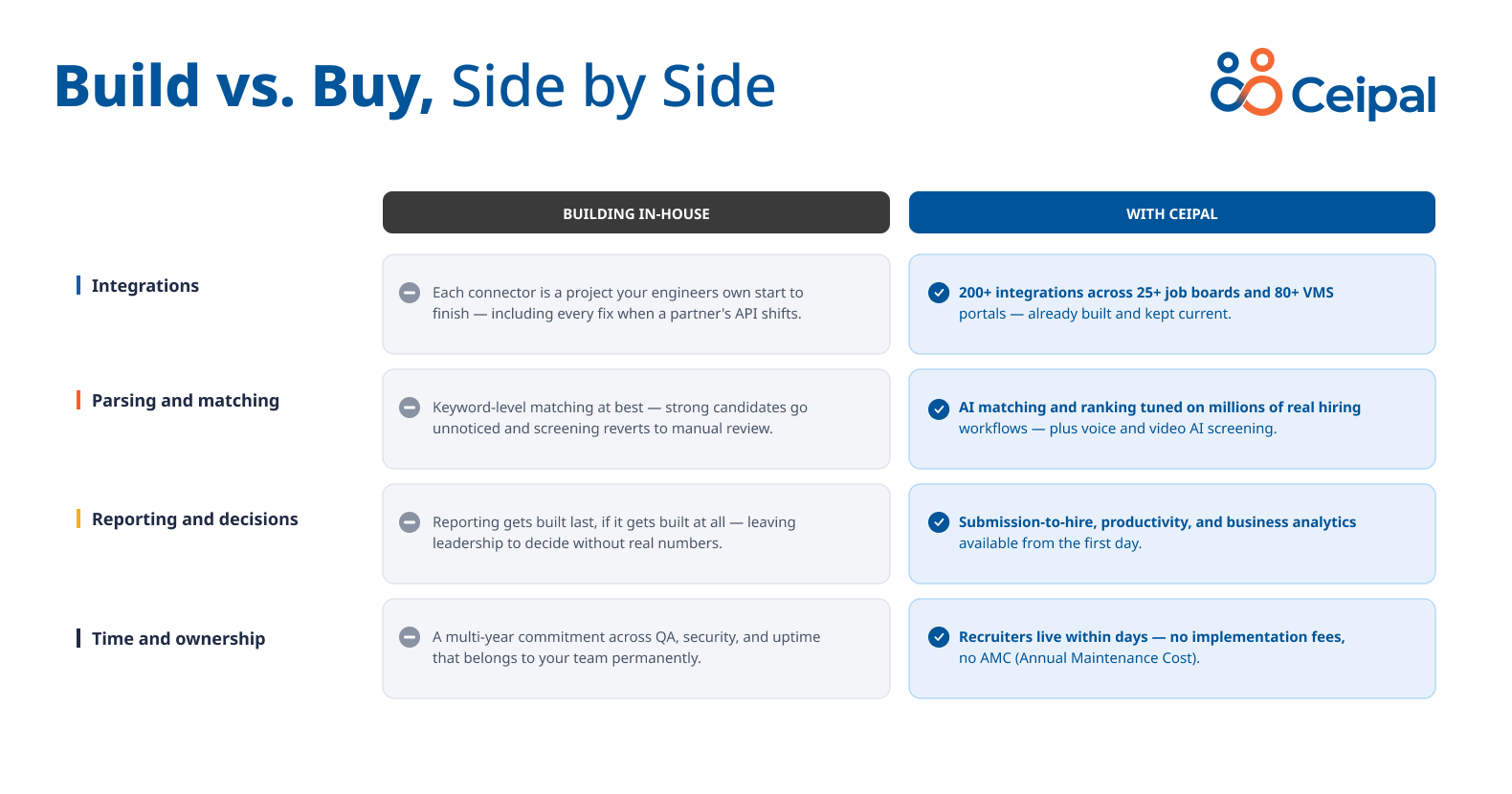
Integrations turn into a maintenance queue. A homegrown ATS has to talk to job boards, VMS portals, calendar tools, and background-check vendors. Each of those connections is your engineers' problem. They have to build it, and then keep it working. Ceipal already maintains 200+ of these connections, which gives you a sense of how much invisible upkeep that number actually represents. On a self-built system, there's no vendor watching for a partner's API update on your behalf. A recruiter just notices one afternoon that submissions have quietly stopped flowing.
Matching quality caps out lower than you'd expect. Matching keywords in a resume against a job description is a solvable weekend project. Ranking candidates the way an experienced recruiter would is a different problem entirely. That takes parsed resume data, role history, and real placement patterns tuned over years against actual hires, not just applications. Firms without that depth tend to see the same failure mode: strong candidates never surface, and screening quietly reverts to a human going through resumes one at a time.
The dashboards arrive last, or never. Ask most in-house build teams for their roadmap and reporting is somewhere near the bottom, after the features that felt more urgent to ship. The cost of that ordering shows up later, in a boardroom: no clear view of submission-to-hire conversion, no read on which recruiters are actually productive, no real-time sense of pipeline health. Leadership ends up steering the business on instinct instead of numbers, at exactly the moment numbers would matter most.
Your team owns every module, indefinitely. Sourcing tools, screening logic, compliance rules, a usable mobile experience - a mature ATS bundles all of it, and each piece represents its own build-and-maintain commitment if you're doing it yourself. That's not a one-time cost. It's an ongoing claim on engineering hours that would otherwise go toward whatever your company is actually trying to build and sell.
None of these four are hypothetical. They're the specific, predictable places where "we'll build it ourselves" quietly turns into a permanent second product your company now maintains, alongside the one you're actually in business to sell.
The part most build-vs-buy conversations skip: Security
Here's the piece that rarely makes it into the pitch at all: the same AI capabilities that make it easy to spin up your own recruiting software also make that software a more attractive, and more vulnerable, target.
IBM's 2025 Cost of a Data Breach Report put the global average cost of a breach at $4.44 million and in the US specifically, that figure hit an all-time high of $10.22 million. Staffing and recruiting firms sit on exactly the kind of data attackers go after: candidate PII, payroll records, immigration documents, and client contracts.
When you buy a purpose-built platform, monitoring, patching, and incident response are somebody's actual job description, a team whose whole role is staying ahead of threats. Build your own, and that responsibility doesn't go away; it just lands on whichever engineers you've already stretched thin building everything else. It's worth sitting with what that really means day to day, at 2 a.m. on a weekend, if something looks off with a candidate database nobody's watched closely in months.
How long does building in-house actually take?
Cost is one problem. Time is the other, and it's easier to underestimate. AI compresses the visible part of a build: the demo. It doesn't compress the invisible part: everything required to make that demo trustworthy at scale.
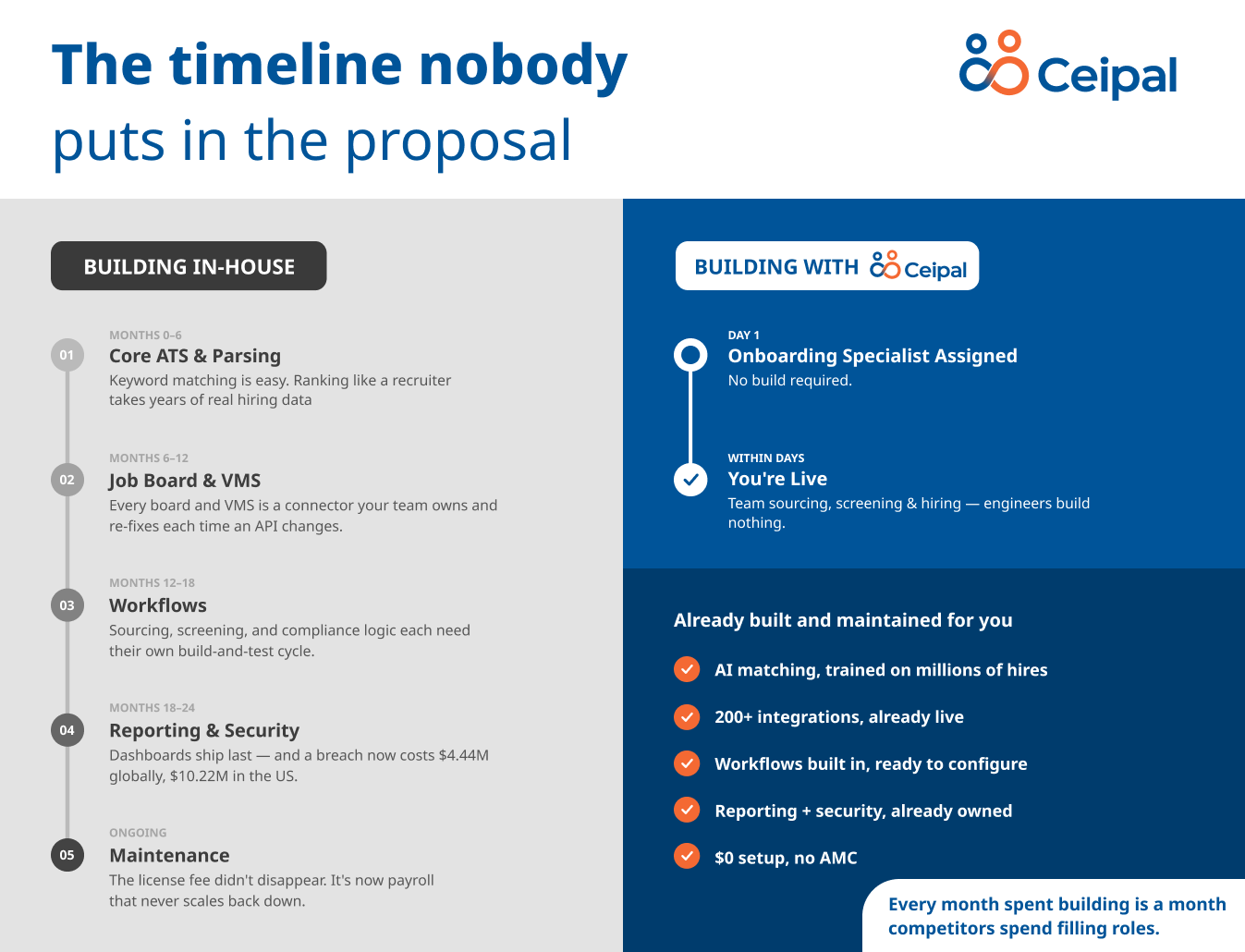
A typical in-house build moves in stages. Core ATS and resume parsing come first, over roughly six months. Job board and VMS integrations take another six. Workflow automation follows. Then reporting, QA, security, and uptime work get layered on top and only after all of that is the system anywhere near what a mature platform already offers out of the box. Maintenance never really ends. Going live on a platform built for this from day one looks different: a dedicated onboarding specialist assigned immediately, and a team live with sourcing, screening, and hiring, within days.
Add it up and the comparison isn't close: roughly two years of engineering to reach basic parity, against a matter of days to have recruiters actually working in the system. Every month spent in that gap is a month your competitors spend closing roles you're still building the tooling to fill.
Build vs. buy, side by side
If you're building a shortlist to evaluate before you decide, our side-by-side product comparisons go deeper on how a purpose-built ATS stacks up feature by feature that’s worth a look regardless of which vendor you're weighing against a homegrown build.
A cautionary tale: What happens when the build doesn't hold
This isn't an abstract risk. It's a pattern we've watched play out with real staffing firms often enough that it's worth telling straight.
ITBrainiac started as a four-person staffing agency that grew fast enough to justify hiring a developer to build its own ATS in-house. For a while, the homegrown system kept up. Then the business kept growing, and it didn't.
Three problems showed up at once. Candidate outreach ran on mass email, which increasingly got caught in spam filters and occasionally jammed the team's own servers under the volume. Job board costs crept up because the system had no way to flag resumes recruiters had already viewed, so the same profiles got downloaded, and paid for, more than once. And with no visibility into who was doing what, a meaningful chunk of the team's day went into manually keying resume details into the system instead of working candidates.
After a year spent evaluating alternatives, ITBrainiac moved to Ceipal. The team was fully up and running within a week. What followed: productivity up 60%, and job board spending down by as much as 40% once integrated search and resume tracking put a stop to double-paying.
That's not a hypothetical outcome from a slide deck. It's what happens when a real staffing firm's homegrown build runs into real growth — and it's a big part of why so many firms end up buying, even after they've already tried building it themselves.
So, should you build or buy?
For most of the organizations, this isn't actually a close call.
Building only makes sense if all three of these are true at once:
Your team's time is better spent on placements and client relationships than on maintaining internal software
You need integrations with job boards, VMS platforms, and productivity tools that already exist and are already maintained
You want AI-assisted matching and reporting that took years to tune, not a version-one attempt
You'd rather have a predictable subscription than an open-ended, growing engineering bill
If you're nodding along to that second list, the decision has already made itself. The only real question left is who you buy from.
Skip the build. Keep the advantage.
None of this is an argument against AI. It's not an argument against your engineering team, either. It's an argument for spending both on what actually differentiates your business.
An ATS, a VMS, and a workforce management platform already exist. They're already integrated with 200+ job boards and VMS portals. More than 2,700 staffing firms already run on this stack, with zero implementation fees and no AMC. Rebuilding that from scratch is rarely where your engineering time is best spent.
Put plainly: the build-vs-buy math hasn't flipped in 2026 just because AI can write more of the code. It's shifted the type of work a build demands from your team such as less time typing, more time owning integrations, security, and uptime for the life of the product. For a software company, that ownership might be the point. For a staffing firm, it's usually a full-time job nobody budgeted for, sitting on top of the placements, client relationships, and candidate experience your business actually runs on.
If you're in the middle of a build vs. buy conversation right now, the fastest way to settle it is to see the alternative sitting next to your own requisitions. Book a 30-minute walkthrough of your actual hiring workflow, live in Ceipal with no build required.
FAQs: Build vs. buy an ATS
Only on day one. Once you factor in security patching, integrations, and ongoing feature work, the total cost of ownership almost always favors buying.
Roughly 24+ months to reach feature parity with a mature platform. Ceipal gets teams live with sourcing, screening, hiring within days.
Ongoing integration upkeep, weaker candidate matching, reporting that arrives last, and security ownership that falls entirely on your team. None of it shows up in a day-one budget.
Rarely, once candidate data and compliance are involved. "Good enough" still has to survive a security audit and a hiring spike — a high bar for a lean team to clear on the side.
AI speeds up the first draft. It doesn't shrink the work after that for security, integrations, uptime, reporting — which is most of what running real software actually takes.





-p-1080.png)