
Slow Hiring Is Becoming GCCs' Biggest Competitive Risk: New Research Reveals Why
June 25, 2026
June 25, 2026

Holly Hunt

June 25, 2026
June 25, 2026
Holly Hunt
Global Capability Centers (GCCs) are taking on increasingly strategic responsibilities, from leading AI initiatives to driving product innovation and improving enterprise productivity. As these organizations evolve beyond traditional delivery centers, their ability to execute depends on having the right talent in place at the right time. Hiring speed is no longer simply an HR metric. It has become a business capability that directly affects how quickly organizations can innovate, scale, and deliver value.
The latest GCC Talentscope India 2026 Report from Ceipal and People Matters suggests many organizations are struggling to keep pace. While GCC leaders have ambitious plans for AI transformation and expanded business ownership, talent acquisition functions are still grappling with lengthy hiring cycles, skills shortages, and reactive recruiting processes. The findings suggest that closing these gaps will be just as important as investing in new technologies.
The report is based on responses from more than 150 CEOs, CHROs, talent acquisition leaders, GCC site heads, and HR executives across industries including IT, financial services, manufacturing, healthcare, consulting, and e-commerce. Together, their responses provide a snapshot of how India's GCC ecosystem is approaching talent acquisition as organizations prepare for the next phase of AI-driven growth.
The research highlights several trends shaping talent acquisition across India's GCC ecosystem.
Taken together, these findings point to a growing disconnect. Business leaders expect GCCs to accelerate innovation and transformation, yet many organizations continue to rely on hiring models that struggle to keep pace with evolving talent demands.
One of the most significant findings in the report is not about hiring at all. It is about how the role of the GCC is changing. Nearly six in 10 respondents identified AI-first transformation and productivity improvement as their top strategic priorities over the next 12 to 18 months, while more than half expect their GCCs to own end-to-end functional capabilities. These priorities reflect a broader shift away from the traditional "build and scale" model toward organizations that are expected to drive innovation and create measurable business value.
This evolution has fundamentally changed what talent acquisition is expected to deliver. Hiring teams are no longer supporting isolated business units or filling vacancies as they arise. They are responsible for enabling enterprise initiatives that depend on highly specialized talent. When hiring slows, the effects extend beyond recruitment metrics. AI implementations are delayed, product roadmaps shift, and transformation initiatives lose momentum. As GCCs continue expanding their strategic role within global organizations, talent acquisition has become a critical enabler of business success rather than simply an operational function.

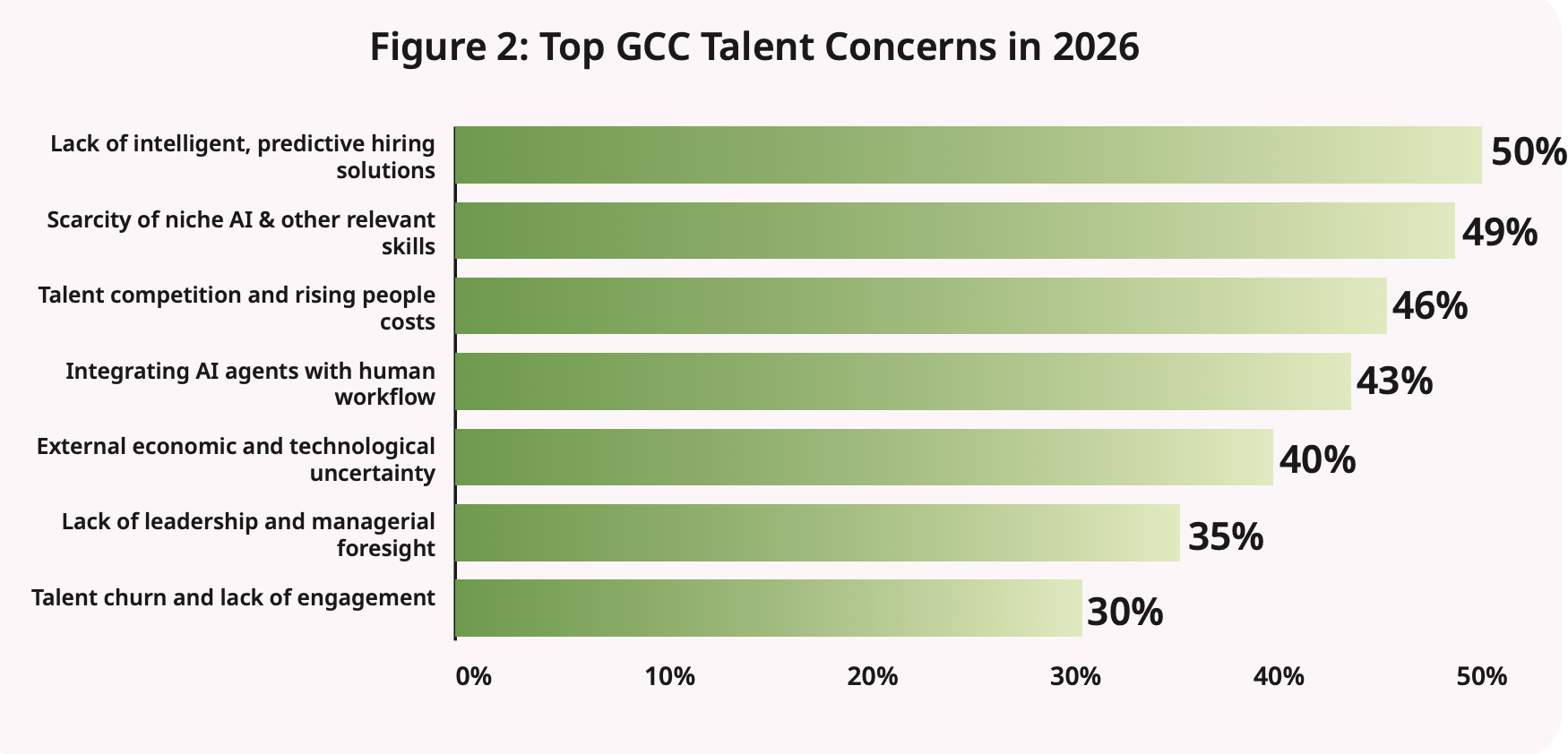
Talent shortages continue to dominate conversations about GCC hiring, particularly as organizations compete for AI, cloud, cybersecurity, and advanced analytics professionals. However, one of the report's more surprising findings suggests that talent scarcity is only part of the story. Half of respondents identified a lack of intelligent, predictive hiring solutions as one of their top talent concerns, making it the highest-ranked hiring challenge in the survey.
This finding suggests many organizations are still recruiting reactively rather than strategically. Hiring efforts often begin only after a business need becomes urgent, forcing recruiters to enter an already competitive market where experienced candidates may receive multiple offers within days. Instead of anticipating future workforce needs and building talent pipelines proactively, many organizations are responding to vacancies after business priorities have already shifted.
The difference between reactive and predictive hiring has become increasingly important as hiring markets tighten. Organizations that invest in workforce planning, labor market intelligence, and skills mapping are better positioned to identify emerging talent needs before they become immediate business risks. Rather than competing for the same candidates at the same time as every other employer, they are able to engage talent earlier and make more informed hiring decisions.
Traditional recruiting metrics focus on measurements such as time-to-fill, cost-per-hire, and recruiter productivity. While these remain valuable indicators, they do not capture the broader business impact of delayed hiring.
Consider what happens when a GCC is preparing to launch a new AI initiative but cannot hire a senior AI architect or engineering leader for two months. Technology investments may already be approved, budgets allocated, and project teams assembled. Yet without the right technical leadership, product development slows, implementation timelines shift, and existing employees take on additional responsibilities while waiting for key positions to be filled.
These downstream effects often carry a much higher cost than the recruiting process itself. Delayed hiring can postpone digital transformation initiatives, extend product development cycles, increase employee burnout, and reduce an organization's ability to respond to new market opportunities. In that context, hiring speed becomes a business performance indicator rather than simply an HR KPI.
Another important takeaway from the research is that technology investments alone are unlikely to solve hiring challenges. While GCCs are aggressively hiring for Generative AI, AI/ML engineering, and data science roles, the report also found significantly lower demand for program leadership, product management, and domain expertise.
That imbalance could create new challenges over time. Successful transformation depends on more than technical specialists. Organizations also need leaders who can manage change, connect technology to business objectives, and translate innovation into measurable outcomes. AI engineers build solutions, but product leaders, transformation managers, and domain experts ensure those solutions deliver value across the organization.
The report highlights the importance of balancing hyper-specialized technical capabilities with what it describes as hyper-integrated skills. Organizations that focus exclusively on technical hiring may accumulate expertise without developing the leadership and business capabilities needed to scale transformation successfully.
The encouraging news is that many GCC leaders recognize the need to modernize their hiring strategies. AI-enabled end-to-end recruitment, agentic AI, and AI-powered talent analytics rank among the top HR technology investment priorities for 2026. These investments signal a shift away from simply automating recruiting tasks toward building more intelligent hiring systems.
Predictive hiring extends beyond automation. It combines workforce planning, labor market intelligence, skills-based hiring, and AI-powered insights to help organizations anticipate talent needs before positions become urgent. Rather than waiting for vacancies to appear, recruiting teams can continuously build relationships with high-value candidates, monitor emerging skills, and align hiring strategies with long-term business objectives.
Recruiters remain central to this process. AI helps automate repetitive administrative work and surface stronger candidate matches more efficiently, allowing recruiters to spend more time advising hiring managers, evaluating talent, and creating a better candidate experience.
The findings from this year's report suggest several priorities for HR and talent acquisition leaders.
First, hiring speed should be treated as a business metric rather than simply a recruiting KPI. Executive leaders should regularly review time-to-hire alongside other strategic performance indicators because prolonged vacancies directly affect transformation initiatives and business outcomes.
Second, organizations should strengthen workforce planning by identifying future capability needs before demand peaks. Predictive planning enables recruiters to build talent pipelines proactively instead of competing for scarce skills only after vacancies arise.
Finally, technology investments should focus on improving decision-making rather than simply increasing efficiency. AI-enabled recruiting, skills intelligence, and predictive analytics can help organizations hire faster, but only when paired with strong recruiting processes and close alignment between talent acquisition and business leadership.
Did you know? Ceipal is an AI-powered platform designed to support GCC needs. Check out product capabilities here.
Hiring is becoming one of the defining competitive advantages for Global Capability Centers. Organizations that can anticipate talent needs, reduce hiring delays, and build balanced capability portfolios will be better positioned to deliver on their AI and business transformation goals.
To explore the full findings, benchmarks, and recommendations, download the complete GCC Talentscope India 2026 Report from Ceipal and People Matters.
According to the GCC Talentscope India 2026 Report, many GCCs are hiring for highly specialized AI, cloud, cybersecurity, and digital transformation roles in an increasingly competitive talent market. At the same time, many organizations still rely on reactive recruiting processes rather than predictive workforce planning, making it harder to identify and secure talent before demand peaks.
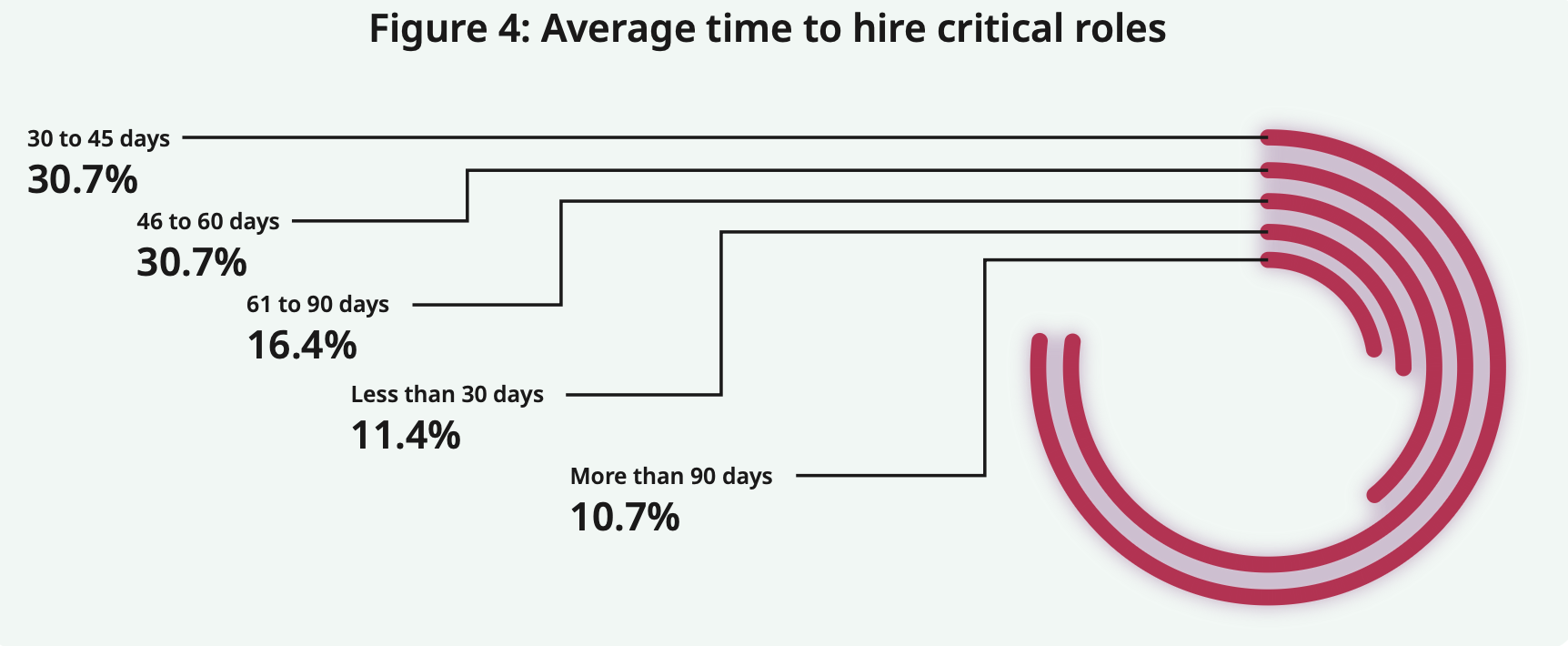
The research found that 58% of GCCs take more than 45 days to fill critical roles, while 27% require more than 60 days. In addition, 44% of organizations reported that more than one-quarter of their critical positions consistently take longer than average to hire.
As GCCs take on larger responsibilities around AI, product development, and business transformation, unfilled positions can delay strategic initiatives, increase pressure on existing teams, and slow innovation. Hiring speed is increasingly viewed as a business performance metric rather than simply an HR KPI.
Predictive hiring uses workforce planning, labor market intelligence, skills data, and AI-enabled recruiting technology to anticipate future hiring needs before vacancies become urgent. Rather than reacting to open requisitions, organizations build talent pipelines proactively, helping reduce time-to-hire for critical roles.
The report points to several strategies, including adopting AI-enabled recruitment technology, building proactive talent pipelines, strengthening workforce planning, embracing skills-based hiring, and aligning talent acquisition more closely with business strategy. Organizations that combine these approaches are better positioned to compete for specialized talent and reduce hiring delays.
The GCC Talentscope India 2026 Report: State of Talent Acquisition in GCCs is based on research conducted by Ceipal and People Matters, including responses from more than 150 CEOs, CHROs, GCC site heads, talent acquisition leaders, and HR executives across India's Global Capability Center ecosystem. The research examines the hiring trends, workforce challenges, technology investments, and strategic priorities shaping talent acquisition in 2026.


-p-1080.png)