If you have been following business news over the last few years, you have probably noticed a term showing up everywhere in job descriptions, investor calls, real estate announcements, and enterprise strategy decks. That term is Global Capability Center, or GCC.
But what exactly is a GCC? How is it different from outsourcing? Why is India hosting more than half of the world's GCCs? And why are companies like Google, Goldman Sachs, Walmart, and Marriott treating their India GCCs as their most strategic global operations?
This blog answers all of it clearly, completely, and without the jargon. Whether you are a GCC enabler, a talent leader, or an enterprise executive exploring your India strategy, this is the complete guide to understanding what GCCs are and where they are headed.
What Is a Global Capability Center?
A Global Capability Center is an offshore or nearshore entity established by a multinational corporation (MNC) to take advantage of lower costs or human or technological resources available in other geographies.
But that definition only tells half the story, and it is the older half.
A Global Capability Center in 2026 is an enterprise-owned capability engine that delivers AI, engineering, analytics, cybersecurity, and digital transformation under direct governance control. It is no longer just about cost savings. It is about owning critical capabilities that influence growth, speed, and resilience. The definition of GCCs has evolved from labor arbitrage to capability arbitrage.
In plain terms: a GCC is your company's own team in another country, fully owned, fully integrated, and increasingly doing some of your most important work.
GCCs are also referred to as captive centers, shared service centers, or global in-house centers, wholly-owned, integrated facilities strategically located in talent-rich regions.
GCC vs. Outsourcing: What Is the Difference?
This is the most common point of confusion, and it matters.
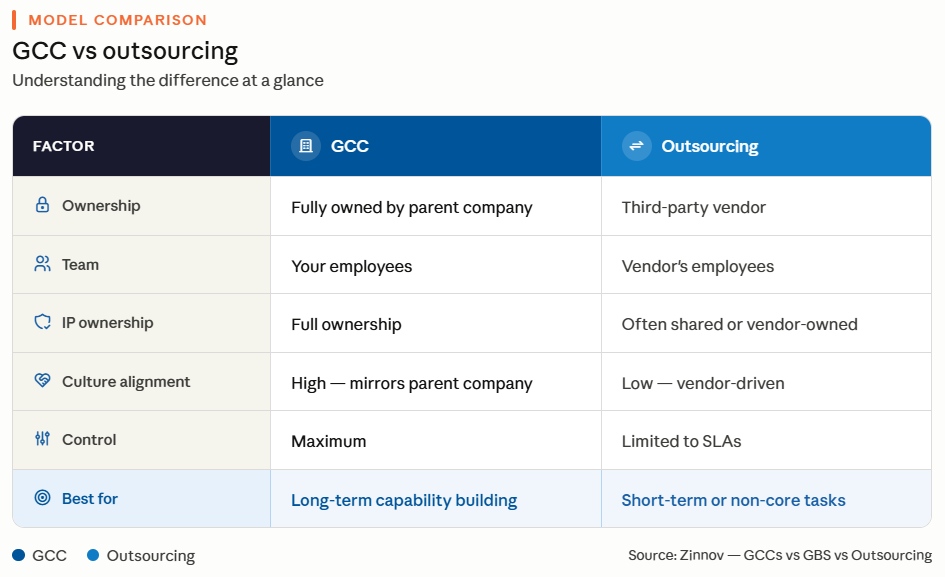
When you outsource, you hire a third-party vendor to deliver a service. You pay for an outcome. You do not own the team, the process, or often the intellectual property.
A GCC is different in a fundamental way. A GCC operates as an internal arm of the company. It mirrors the organization's culture, processes, and long-term roadmap, making it more aligned and agile. The GCC operates as an extension of the headquarters, not a vendor. It brings consistency, control, and deep ownership while leveraging global talent and cost advantages.
GCC vs. Outsourcing difference
What Functions Do GCCs Handle?
The scope of what GCCs do has expanded dramatically over the last few years. GCCs run software development, product engineering, and R&D for their global operations. Data analytics, artificial intelligence, and machine learning teams power digital transformation initiatives from India. Finance, accounting, and payroll operations are centralized for cost optimization and accuracy. HR services, talent acquisition, and customer experience teams support business continuity across time zones.
In 2026, the most active GCC functions include:
Engineering and product development: Building and maintaining global software platforms
AI, ML, and data analytics: Powering enterprise intelligence and automation
Cybersecurity: Managing global threat detection and compliance
Finance and accounting: Centralized financial operations across geographies
Customer experience: Global support and service operations
R&D and innovation: Original research and product incubation
Legal, compliance, and risk: Governance and regulatory operations
67% of GCCs are now creating dedicated innovation teams and incubation programs to generate, test, and globalize ideas from India. Budget allocations reflect this shift: 25% of GCC resources go into technology and transformation, and 23% toward talent development.
Why India? The GCC Capital of the World
India does not just lead the world in GCC count. It dominates by a margin that no other country comes close to matching.
India hosts over 1,800 GCCs as of late 2025—more than half the world's total. These centers employ nearly 2 million professionals and generated $64.6 billion in revenue in FY2024. By 2030, India is expected to host over 2,500 GCCs employing 2.8–2.9 million professionals, contributing an impressive $105 billion in revenue to the global economy.
What makes India the default choice for global enterprises?
Talent depth at scale: India's pool of highly skilled technical as well as non-technical talent is one of its key advantages. From engineers and developers to cybersecurity, cloud, and crypto specialists, India's talent pool remains unbeaten. India produces over 2.5 million STEM graduates annually, a pipeline no other country can match at this scale.
Cost advantage without capability compromise: Global companies get 30 to 60% cost savings on operations, full IP ownership, and access to a deep talent pool across artificial intelligence, cloud computing, and product engineering.
Government support: India's Union Budget 2025–26 announced a National Framework for GCCs to promote global capability centers in emerging Tier II cities, and MeitY is building a Single Window Portal to streamline approvals nationwide. 100% foreign investment is allowed under the automatic route for IT services and most GCC-relevant sectors, with no prior government approval needed.
Mature ecosystem: The ecosystem of BOT firms, advisors, real estate partners, and talent networks makes India the most operationally ready GCC destination in the world.
Where Are GCCs Located in India?
As of June 2026, according to Espark Info's report, 90% of GCCs are set up in six cities: Bengaluru, Chennai, Hyderabad, Delhi NCR, Mumbai, and Pune.
Here is how the major cities stack up:
Bengaluru is India's undisputed GCC capital, home to nearly 900 GCC units and roughly 35–40% of all GCC activity. It is the default choice for deep tech, AI, and engineering-heavy mandates. Companies like Google, Microsoft, and Goldman Sachs have some of their largest global operations here.
Hyderabad is the fastest-growing GCC city, capturing 20–23% of the market with a strong focus on BFSI, analytics, and enterprise platforms. Vanguard, McDonald's, T-Mobile, and UBS have all made significant GCC commitments here recently.
Pune is India's engineering and ER&D hub, strong in automotive tech, industrial software, and enterprise SaaS. BMW, Medtronic, and Mercedes-Benz Tech all operate out of Pune.
Delhi NCR (Gurugram/Noida) is rapidly scaling for financial services, analytics, and enterprise tech, and is growing fast as a complement to Bengaluru and Hyderabad.
Chennai has a strong presence in healthcare, manufacturing, and engineering, with Walmart's second India GCC landing here in 2025.
GCCs in Tier II citiessuch as Ahmedabad (GIFT City), Coimbatore, Indore, Jaipur, and Kochi are gaining ground fast, with India's government actively promoting GCCs in emerging Tier II cities through its National Framework.
What Are the Different GCC Models?
Not every GCC is set up the same way. The model you choose depends on how much control you want, how fast you need to move, and how much risk you are willing to take on early.
Captive Model (Fully Owned) In the captive model, the parent company fully owns and operates the GCC, maintaining complete control over strategy, operations, and talent. This model offers maximum transparency, data security, and alignment with global objectives and is best suited for large enterprises.
BOT Model (Build-Operate-Transfer) Under the BOT model, a local partner sets up and runs the GCC for a defined period before transferring ownership to the parent company. This approach reduces initial risk, accelerates setup, and allows structured knowledge transfer during the transition.
ABO Model (Advisory-Build-Operate) A consulting-led variation where an advisory firm designs the GCC strategy, oversees the build, and manages operations, commonly used by mid-market enterprises entering India for the first time.
Hybrid Model A combination of owned operations and third-party support, typically used by companies that want to scale fast while maintaining governance over core functions.
Many enterprises begin with vendor-supported acceleration and evolve toward deeper enterprise control as governance matures. The right GCC setup model grows with organizational ambition.
Who Is Setting Up GCCs in India?
Almost every major multinational in technology, financial services, healthcare, manufacturing, and consulting has an India GCC. The list includes names you would expect: Google, Amazon, Goldman Sachs, JPMorgan, Novartis, Boeing, but also hundreds of mid-size companies you might not associate with India: regional European banks, US healthcare systems, specialty chemical companies, and industrial conglomerates.
US-headquartered firms drive 70% of all GCC demand. But the profile of GCC entrants is broadening rapidly. European FMCG companies like Carlsberg and Sanofi, Middle Eastern real estate groups like DAMAC, and global hospitality brands like Marriott have all set up GCCs in India in the last two years.
Around 110 new global capability centers were set up in India between 2024 and 2025 alone. In 2026, the pace has not slowed; if anything, it has accelerated.
What Skills Are GCCs Hiring For in 2026?
The talent mandate inside GCCs has shifted significantly. The highest-demand skills are GenAI/LLM engineering, cloud architecture, cybersecurity, data engineering, and domain-specialist hybrid roles combining technical and domain expertise.
Professionals with GenAI and LLM engineering skills command a 30–40% premium above the standard software engineering range. Leadership roles (Director and above) in mature GCCs regularly exceed ₹1 crore annually in total compensation, including ESOPs and RSUs, which 75% of GCCs now offer beyond the leadership level.
GCCs project salary increments of 10.4% in 2026 versus 9.6% for IT services, and typically pay 20–35% more for equivalent roles at the mid-senior level.
GCC vs. MNC: Are They the Same Thing?
This is a question that comes up often, especially for professionals considering a career in the GCC space. Not exactly. An MNC (multinational corporation) is the parent company. A GCC is the MNC's wholly owned offshore or nearshore subsidiary. When people say "I work at a GCC," they mean they work at the India unit of a global MNC.
So Google is the MNC. Google India's engineering and product center in Hyderabad or Bengaluru is the GCC.
The Talent Infrastructure Challenge Behind GCC Growth
Here is where the GCC story gets more complex and more important.
The pace of GCC growth in India is extraordinary. But the talent infrastructure keeping up with that growth is under pressure.
58% of GCCs take more than 45 days to fill critical roles
50% are making hiring decisions without predictive analytics
Agentic AI in recruitment is the #1 HR tech priority, yet most hiring infrastructure is not built to support it
As more GCCs launch and scale, the war for mid-senior talent in AI, cloud, and platform engineering is intensifying. The GCCs winning that war are not just the ones with the strongest employer brands; they are the ones with the strongest talent infrastructure. Structured hiring workflows, vendor governance, predictive analytics, and AI-enabled recruitment operations are no longer optional. They are the difference between a GCC that scales confidently and one that struggles to keep pace with its own ambitions.
That is exactly the problem Ceipal was built to solve. As a talent infrastructure platform purpose-built for GCC growth, Ceipal helps GCC leaders centralize hiring operations, coordinate multiple vendors, and build the visibility and governance needed to scale a world-class workforce from launch through expansion.
The World Is Building Here. Are You Ready?
A Global Capability Center is no longer just an offshore cost-saving play. By 2026, the most successful GCCs behave like internal startups: agile, cross-functional, insight-driven, and deeply aligned with global business outcomes. For any multinational enterprise thinking seriously about long-term growth, innovation velocity, and access to deep talent, the question is no longer whether to set up a GCC in India. It is how to build one that is ready for what comes next.
Want to see how Ceipal’s all-in-one talent infrastructure can support GCCs? Sign up for a quick demo of the platform capabilities.
Frequently Asked Questions
What does GCC stand for? GCC stands for Global Capability Center. It is also sometimes referred to as a Global In-house Center (GIC), captive center, or shared services center.
What is the difference between a GCC and BPO? A BPO (Business Process Outsourcing) provider is a third-party vendor delivering services on your behalf. A GCC is wholly owned and operated by the parent company: your employees, your culture, your IP.
How many GCCs are there in India? India hosts over 1,800 GCCs as of late 2025, employing nearly 2 million professionals, more than half the world's total GCC count.
Which city in India has the most GCCs? Bengaluru leads with most of the GCC units, followed by Hyderabad, Pune, Delhi NCR, Chennai, and Mumbai.
How much does it cost to set up a GCC in India? A 50 to 100-person GCC costs $500,000 to $2 million in setup investment, with annual operating costs 40 to 60% lower than the US or Europe.
What is the future of GCCs in India? The GCC sector is projected to cross $100 billion by 2030. NASSCOM projects the GCC ecosystem will expand to 2,100–2,200 centers by 2030, with a workforce of 2.5–2.8 million.




-p-1080.png)