
From Cost Centers to Value Creators: The New Strategic Mandate for GCCs
July 13, 2026
July 2, 2026

Holly Hunt

Tags:

July 13, 2026
July 2, 2026
Holly Hunt
Global Capability Centers (GCCs) have spent years proving their ability to scale operations efficiently. Today, many are being asked to do something much bigger.
As organizations accelerate AI adoption and rethink how work gets done, GCCs are becoming strategic partners responsible for innovation, product development, and enterprise transformation. Success is no longer measured primarily by headcount growth or cost savings. Increasingly, it is measured by business outcomes.
The latest GCC Talentscope India 2026 Report from Ceipal and People Matters highlights just how quickly this evolution is taking place. The research found that 59% of GCC leaders identify AI-first transformation as one of their highest strategic priorities over the next 12 to 18 months. Another 59% say improving productivity and process excellence is equally important, while 54% expect their organizations to take ownership of end-to-end business capabilities.
The report is based on responses from more than 150 CEOs, CHROs, talent acquisition leaders, GCC site heads, and HR executives across industries including IT, financial services, manufacturing, healthcare, consulting, and e-commerce. Together, the findings paint a picture of an ecosystem moving beyond operational execution toward long-term value creation.
The research highlights several trends shaping the future of GCCs.
Taken together, these findings suggest that GCCs are entering a new phase of maturity. Growth remains important, but organizations are increasingly focused on how they create value, improve performance, and enable enterprise-wide transformation.

For many years, GCCs were primarily evaluated on operational efficiency. Organizations expanded their teams to support global business functions, improve service delivery, and optimize costs. Scale was often viewed as the clearest indicator of success.
That model is evolving.
Today's GCCs are increasingly expected to own strategic initiatives that directly influence business performance. They are building AI solutions, developing digital products, improving customer experiences, and helping shape enterprise strategy. Rather than supporting innovation elsewhere in the organization, many GCCs are now expected to lead it.
This evolution represents more than a change in responsibilities. It changes how organizations invest in technology, structure teams, and measure performance.
One of the most interesting findings in the research is that AI transformation and productivity improvement rank equally among GCC leaders' priorities.
At first glance, these may appear to be separate objectives. In reality, they are closely connected.
Organizations are not investing in AI simply because the technology is advancing rapidly. They are investing because they expect AI to improve how work gets done. Whether that means automating repetitive tasks, accelerating software development, improving decision-making, or helping employees work more efficiently, AI has become a means of achieving broader business outcomes rather than an end in itself.
This distinction matters because it shifts the conversation away from technology adoption and toward business impact. The organizations that realize the greatest value from AI will likely be those that successfully redesign workflows, develop new capabilities, and enable employees to work differently alongside intelligent technologies.
Another notable finding is that more than half of respondents expect GCCs to own end-to-end functional capabilities over the next 12 to 18 months.
That represents a significant shift in responsibility.
Owning a business function requires more than executing assigned work. It requires leaders who can make decisions, manage risk, improve processes, and deliver measurable outcomes. It also requires closer collaboration across technology, operations, finance, HR, and business teams.
As GCCs assume greater ownership, organizations will need to think differently about the capabilities they build. Technical expertise remains essential, but so do product leadership, transformation management, business strategy, and deep domain knowledge. The most successful organizations will develop teams that combine these complementary skills rather than emphasizing technical specialization alone.
The report makes another point that deserves attention: organizations cannot achieve ambitious business goals without evolving how they approach talent.
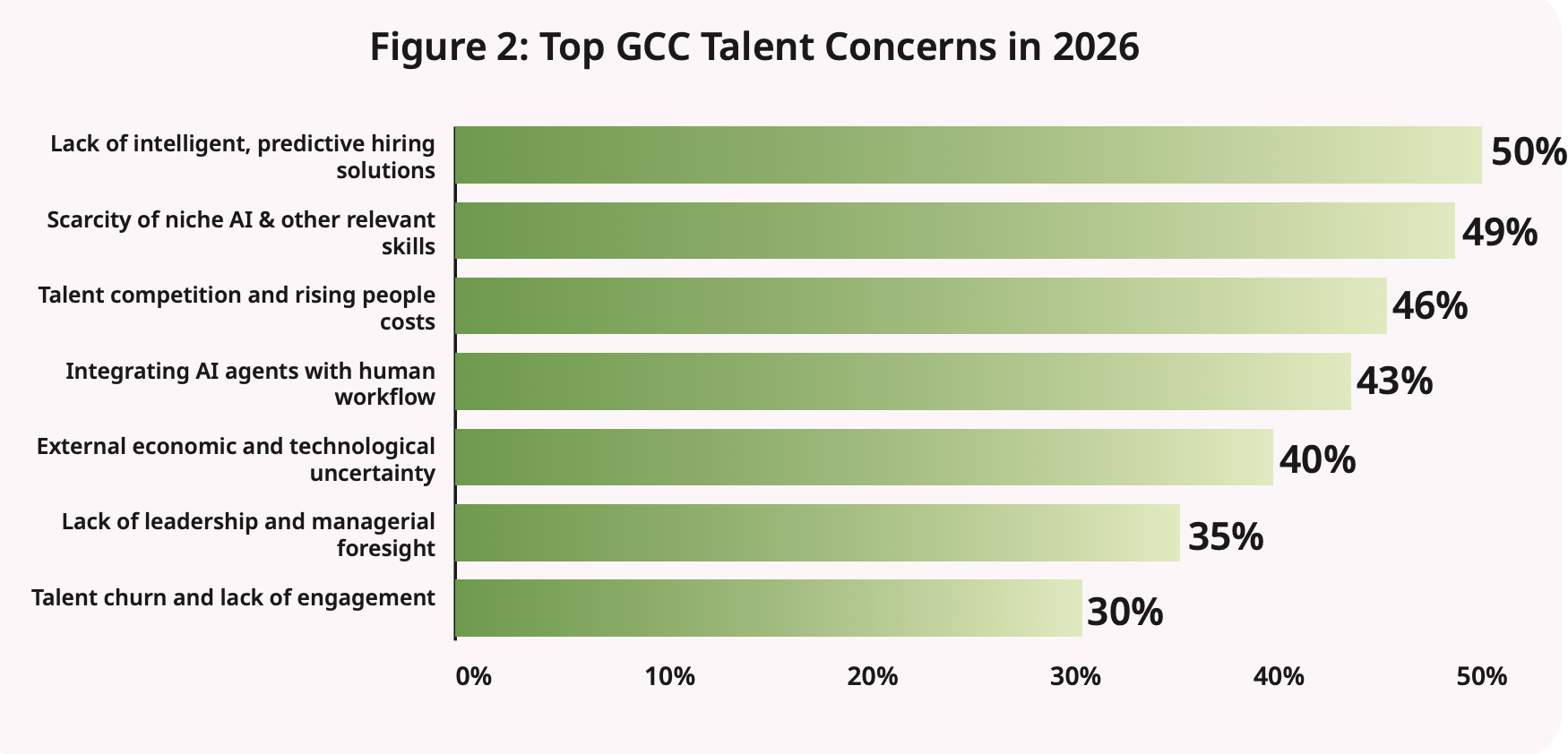
Many respondents identified a lack of intelligent, predictive hiring solutions as one of their biggest challenges. At the same time, AI-enabled recruitment and talent analytics rank among the highest HR technology investment priorities.
These findings suggest that talent acquisition is becoming more closely aligned with business strategy than ever before.
When organizations are expected to build AI capabilities, launch new products, or expand business ownership, hiring can no longer operate as a reactive function. Workforce planning, skills intelligence, and proactive talent pipelines become essential components of organizational strategy because they determine how quickly business priorities can become reality.
The conversation is no longer simply about filling vacancies. It is about ensuring the business has the capabilities needed to execute its strategy.
Technology alone will not define the next generation of successful GCCs.
AI platforms will become increasingly accessible. Automation tools will continue to improve. Organizations across every industry will invest heavily in new technologies.
The differentiator will be leadership.
Leaders will decide where AI creates the greatest value, how organizations redesign work, how employees develop new skills, and how technology supports broader business objectives. They will also determine whether talent acquisition, workforce planning, and organizational design evolve quickly enough to support those ambitions.
In many ways, the future of GCCs will be shaped less by the technology they purchase and more by the organizational capabilities they build around it.
The findings suggest several priorities for organizations preparing for the next stage of growth.
First, evaluate success using business outcomes rather than operational metrics alone. AI initiatives should improve productivity, accelerate innovation, and strengthen enterprise performance rather than simply increase technology adoption.
Second, align talent strategy with business strategy. Hiring plans, workforce planning, and leadership development should directly support the capabilities organizations expect to own over the coming years.
Finally, invest in balanced capability building. Technical expertise remains essential, but organizations also need product leaders, transformation managers, and business experts who can turn technology investments into measurable results.
The GCC Talentscope India 2026 Report found that AI transformation and productivity improvement are now the leading strategic priorities for GCCs. Organizations are investing in AI to improve business performance, streamline operations, and support enterprise-wide transformation.
Many GCCs are evolving from operational delivery centers into strategic business partners responsible for innovation, product development, AI initiatives, and end-to-end business capabilities.
As GCCs take on greater business ownership, organizations need specialized talent earlier and more consistently. Predictive workforce planning, AI-enabled recruitment, and skills-based hiring help ensure business priorities can be executed without unnecessary delays.
The research suggests organizations will need a balanced mix of AI expertise, cloud engineering, cybersecurity, product management, transformation leadership, and industry-specific knowledge to support long-term growth.
Business leaders should align AI investments, talent strategy, workforce planning, and organizational design around measurable business outcomes. Organizations that build both technical and leadership capabilities will be better positioned to create lasting competitive advantage.
The GCC Talentscope India 2026 Report: State of Talent Acquisition in GCCs is based on research conducted by Ceipal and People Matters, including responses from more than 150 CEOs, CHROs, GCC site heads, talent acquisition leaders, and HR executives across India's Global Capability Center ecosystem. The research examines the hiring trends, workforce challenges, technology investments, and strategic priorities shaping GCC talent acquisition in 2026.
The next generation of GCCs will be defined by more than their ability to scale. As organizations become strategic drivers of AI, innovation, and business transformation, success will depend on how effectively they align technology, talent, and long-term business strategy.
Download the full GCC Talentscope India 2026 Report to explore the complete findings, benchmarks, and recommendations from Ceipal and People Matters.


-p-1080.png)