All around the United States, healthcare facilities are running on borrowed time. The need for reliable healthcare staffing has never been greater, with nursing shortages projected to surpass 500,000 RNs by 2030 and physician shortfalls growing annually. It's not just a workforce problem; it's a commercial opportunity that's right in front of you.
Establishing a healthcare staffing firm places you at the intersection of a real human need and a multi-billion-dollar industry. However, you can't wing this kind of business. Before the first placement is made, there’s a lot of infrastructure to be built, including state licensure, credentialing compliance, and the high-stakes nature of placing doctors in patient-facing roles. The good news? You might be surprised at how clear the roadmap is.
What Does a Healthcare Staffing Agency Actually Do?
A healthcare staffing agency links qualified clinicians, whether nurses, physicians, allied health professionals, or locum tenens providers, with hospitals, clinics, and health systems that need them. The healthcare facility receives vetted talent without the expense of a full recruitment operation, while the agency handles sourcing, credentialing, compliance, and placement.
Consider it similar to a matchmaking service, but with patient safety at risk. That's why this segment demands more rigor than general staffing. Credentials expire. Licenses vary by state. Background checks aren't optional. It's all about getting those details correct.
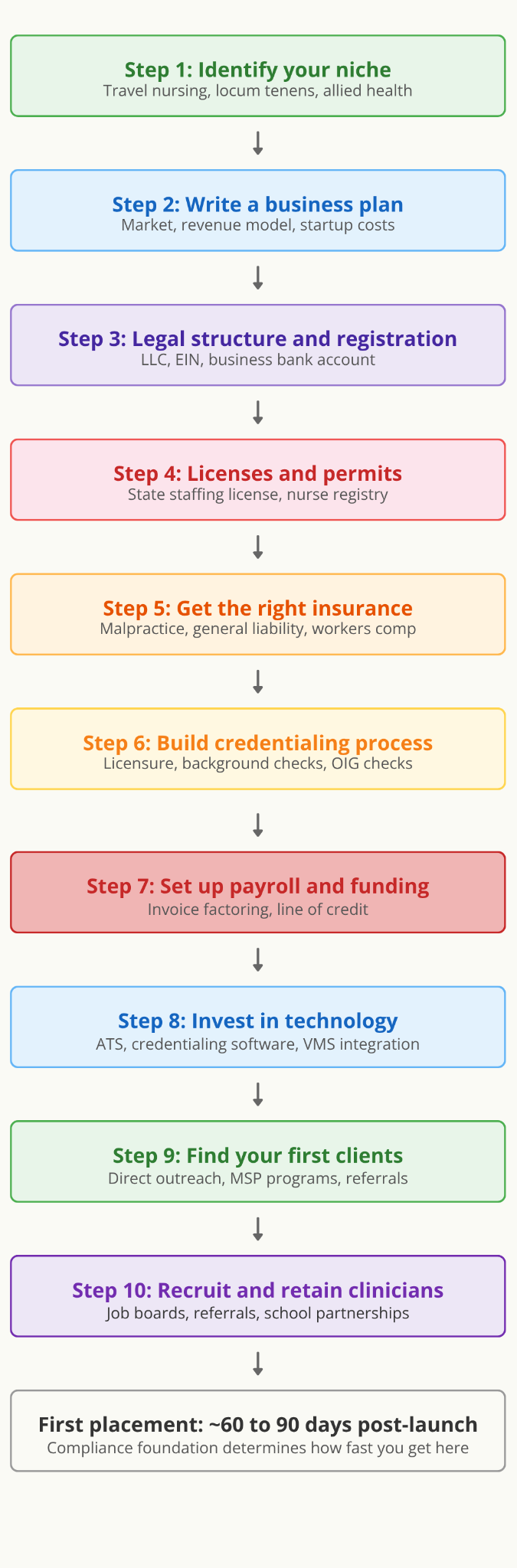
The Roadmap to Start a Healthcare Staffing Agency
Step 1: Identify Your Niche
The biggest mistake new agencies make is trying to be everything to everyone from day one. There are a number of different verticals in healthcare staffing, and each has its own client expectations, compensation structures, and compliance requirements.
Travel nursing: High demand, high pay, fast placements. Requires managing per diems, housing stipends, and multi-state licensure.
Locum tenens: Physician and advanced practice staffing. Longer lead times, higher fees, deeper credentialing requirements.
Per diem nursing: Shift-based placements for local facilities. Lower pay rates but faster volume.
Allied health: Physical therapists, radiology techs, respiratory therapists, lab professionals. Steady demand, less saturated than nursing.
Permanent placement: Direct hire for hospitals seeking full-time staff. Less operational complexity, but margin is thinner.
Pick one or two verticals to start. Build expertise, refine your compliance processes, and scale from there.
Step 2: Write a Business Plan
Create a strong business plan before submitting any paperwork. It forces clarity on the things that matter most.The plan should entail:
Revenue model: Will you charge facilities a percentage of direct hires' annual salaries, a flat placement fee, or a markup on hourly rates?
Startup costs: Take into account legal fees, insurance, ATS/software subscriptions, licensing fees, and the fact that staffing firms typically fund payroll before client invoices clear.
Growth timeline: In order to break even, how many placements are required in the first month? in the sixth month?
A business plan also conveys a sense of seriousness to potential investors, lenders, or bank partners, which matters more than most new agency owners expect.
Step 3: Choose a Legal Structure and Register Your Business
Taxes, liability, and capital raising are all impacted by the legal form you choose. LLCs, corporations, partnerships, and sole proprietorships are among the options; each with different trade-offs. Most healthcare staffing agencies launch as an LLC given the combination of liability protection and operational flexibility. After selecting a structure, register with your state's Secretary of State office, obtain an Employer Identification Number (EIN) from the IRS, and open a dedicated business bank account.
Step 4: Obtain Licenses and Permits
This is where general staffing and healthcare staffing diverge significantly. States have very different licensing requirements, and operating without the right permits can lead to fines, contract loss, or criminal prosecution. Key licensing considerations:
State staffing agency license: Many states require a specific healthcare or employment agency license. Examine the criteria set forth by the Department of Labor or the Department of Health in your state.
Nurse registry license: Some states require a separate license if you're placing nurses specifically.
Multi-state operations: You must stay current with the regulations of each state if you want to assign employees across state lines. Platforms that track state-by-state regulatory updates are worth the investment early.
Federal compliance: Every agency must, a minimum, abide by IRS employer obligations, FLSA wage standards, and EEOC principles.
It is suggested to work with a healthcare staffing attorney early on and invest in a compliance tracking technology because rules are subject to annual changes.
Step 5: Get the Right Insurance
Insurance is non-negotiable in healthcare staffing. Placing clinicians in a patient-facing setting carries a high risk profile, and a single malpractice without coverage can end an agency. The core policies you'll need:
Professional liability: Covers claims arising from clinical errors made by placed staff.
General liability: Covers operational risks, from a slip in your office to a contract dispute.
Workers' compensation: Required in most states for any W-2 employees, including placed clinicians.
Cyber liability: Increasingly important given the volume of sensitive clinical and personal data agencies handle.
Instead of working with a generalist broker, choose one who specializes in staffing insurance. Someone familiar with the landscape is necessary because of the intricacies of healthcare locations.
Step 6: Build Your Credentialing Process
Credentialing is the backbone of a healthcare staffing agency's credibility. Before a clinician is placed, they must undergo thorough verification. Typically, credentialing includes:
Active state licensure and expiration tracking
Board certifications and specialty credentials
Background checks and drug screening
Reference verification
OIG exclusion list checks (required for Medicare/Medicaid-participating facilities)
Immunization and health screening records
Even if your initial clients don't formally demand it, the industry standard is to create a credentialing checklist based on Joint Commission and NCQA requirements. It signals professionalism and protects you when clients upgrade their compliance expectations.
Step 7: Set Up Payroll and Funding
Cash flow is the silent killer of new staffing agencies. The issue is that although clients pay invoices on periods of 30 to 60 days, you pay doctors on a weekly basis. Growth can be severely hampered by that gap if you are unprepared.
Two common approaches agencies use to manage this:
Payroll funding: Arrangements where outstanding invoices are advanced so payroll can be met without waiting on client payment cycles.
Business line of credit: A revolving credit facility drawn as needed and repaid as invoices clear, typically better suited for agencies with an established banking relationship.
Before making the initial placement, properly model your cash flow needs. Rarely do undercapitalized staffing firms make it past their initial phase of expansion.
Step 8: Invest in the Right Technology
Agencies that scale differentiate from those that remain trapped in spreadsheets by technology. A healthcare staffing company must, at the very least, have this tech stack:
Credentialing and compliance tools: Ideally integrated into the ATS, so license expirations trigger automated alerts.
VMS integration capability: Many large health systems manage their staffing vendors through a Vendor Management System. Being VMS-compatible is often a requirement to get on preferred vendor lists.
Invoicing and billing software: Automate invoicing to reduce admin overhead and accelerate payment cycles.
Agencies that use AI-powered sourcing and matching technologies will have the highest growth in 2026. The gap between tech-enabled and manual agencies is widening every quarter, with 45% of agencies currently using AI into their recruiting processes.
Without facility contracts, there are no placements. Without placements, there is no agency. In healthcare staffing, client acquisition typically looks like this:
Direct outreach: Contact HR directors, nurse managers, and chief nursing officers at local hospitals, long-term care facilities, and outpatient clinics.
GPO and network memberships: Access to multiple facilities at once can be expedited by joining a regional healthcare network or Group Purchasing Organization.
Referrals: A single satisfied client who recommends you to a peer system is worth more than any cold call.
MSP programs: Larger health systems source temporary staff through Managed Service Provider programs. Significant volume potential arises when a vendor is registered as an approved vendor in an MSP network.
Your main selling factors should be competitive terms and a solid compliance record. In this industry, contracts are not won by rate alone.
Step 10: Recruit and Retain Your Clinician Talent Pool
A healthcare staffing agency is only as good as the clinicians it can place. Building a reliable, credentialed talent pool takes time and intentional effort.
Proven recruitment channels include:
Job boards specializing in healthcare (Indeed, ZipRecruiter, specialty nursing boards)
Social media, particularly LinkedIn and nursing-specific Facebook groups
Employee referral programs
Partnerships with nursing schools and residency programs
Attendance at healthcare job fairs and professional conferences
Retention matters just as much. Your reputation will naturally grow if your clinicians feel well-supported, well rewarded, and consistently placed. Being the organization that treats people well is a huge differentiation in a market where 40% of nurses are thinking about quitting the field completely.
Build It Right From Day One
Starting a healthcare staffing agency is not a passive income play. It is an operationally demanding, relationship-driven, compliance-heavy business that demands significant infrastructure investment from the start. However, there is a significant opportunity for those who construct it well. The need for well-managed staffing firms is not going away anytime soon because the U.S. healthcare workforce shortage is structural rather than cyclical.
FAQs
1. How much does it cost to start a healthcare staffing agency?
Startup costs for a healthcare staffing agency typically range from $10,000 to $100,000 or more depending on scale, state licensing fees, and how you plan to fund payroll. Core expenses include state licensing and registration fees, business insurance (particularly professional liability), ATS and credentialing software, legal costs for contract drafting, and working capital to bridge the gap between paying clinicians and collecting from clients. A lean launch focused on one specialty and one geography can significantly reduce initial capital requirements.
2. Is a healthcare staffing agency profitable?
Yes, healthcare staffing agencies can be highly profitable, particularly in high-demand specialties like travel nursing, locum tenens, and allied health. Revenue is typically generated through a markup on clinician hourly rates or a placement fee for direct hires, usually 15 to 25% of first-year salary. Profitability depends on managing the margin between what facilities pay and what clinicians earn, keeping overhead lean, and maintaining a steady pipeline of both clients and credentialed talent. Agencies that invest in technology to reduce manual work tend to reach profitability faster.
3. What licenses do you need to start a healthcare staffing agency?
Licensing requirements vary by state, but most agencies need a state-issued employment or staffing agency license, and some states require a separate healthcare or nurse registry license. All agencies must comply with federal regulations including EEOC guidelines, FLSA wage requirements, and IRS employer obligations regardless of location. Agencies placing staff across multiple states need to track and maintain compliance in each state individually, as requirements differ and change annually. Working with a healthcare staffing attorney or compliance tracking tool from the start is strongly recommended.
4. How do healthcare staffing agencies find clients?
Healthcare staffing agencies typically build their client base through direct outreach to hospital HR directors, nurse managers, and chief nursing officers at local facilities. Joining Group Purchasing Organizations (GPOs) or regional healthcare networks can provide faster access to multiple facility relationships at once. Getting listed as an approved vendor in a Managed Service Provider (MSP) program opens access to larger health systems that source contingent staff through centralized vendor platforms. Referrals from satisfied clients remain one of the most reliable and cost-effective acquisition channels for growing agencies.
5. How long does it take to start a healthcare staffing agency?
Most healthcare staffing agencies can be operational and make their first placement within 60 to 90 days of starting the setup process, assuming licensing, insurance, and at least one facility contract are in place. The timeline depends heavily on how quickly state licensing is approved, which varies by state, and how fast a credentialed talent pool can be built. Travel nursing and per diem placements typically move faster than locum tenens, which involves longer credentialing timelines and more complex contract negotiations. Agencies that build their compliance and technology infrastructure early tend to reach their first placement faster.


.png)


-p-1080.png)